
You have done everything right: set up your Google Business Profile, collected a handful of solid reviews and built a decent website. But your competitor down the street keeps showing up above you in local search results and you genuinely can not figure out why.
Here is something a lot of local business owners never think to check: is your business name, address and phone number written the exact same way on every single platform across the internet? Not similar. Identical.
If the answer is “I’m not sure,” there is a good chance that it is holding you back.

It sounds almost too simple to matter. But NAP consistency, the practice of keeping your Name, Address and Phone Number uniform across every online directory, citation and platform, is one of the most foundational trust signals in local SEO.
Miss it and Google quietly loses confidence in your business. Nail it, and you gain a real edge over competitors who have not bothered.
In this guide, we will be going to break down what NAP consistency actually means, why it still matters in 2026, what happens when it goes wrong and most importantly, how to fix it step by step.
What Is NAP Consistency?
NAP stands for Name, Address and Phone Number. The three pieces of information that act as your business’s identity across the internet. You will find your NAP listed on your website, Google Business Profile, Apple Maps, Yelp, Facebook, Yellow Pages, industry directories, review platforms and countless other places.
NAP consistency means these three details are written the same way, every time, everywhere (not just accurate, but uniformly formatted). Many SEOs also track what is called NAP+W, which adds your website URL to the mix, since it helps tie all your listings back to a single authoritative source.
What most people do not realize is that even minor formatting differences count as inconsistencies in the eyes of search engines. Things like:
- “Main Street” on your website vs. “Main St.” on Yelp
- “+1 (555) 123-4567” on Google vs. “555.123.4567” on Facebook
- “Joe’s Bakery LLC” in one place vs. “Joe’s Bakery” in another
- An old phone number is still sitting in a directory you forgot about
Each of these small variations creates doubt for Google’s crawlers, and that doubt directly chips away at your local search visibility.
Why NAP Consistency Matters for Local SEO in 2026
Search engines are fundamentally trust machines. Their entire job is to give users the most reliable, accurate results possible. When Google is deciding which local businesses to show for a “near me” search or in the Local Map Pack, it cross-references your business information across dozens of platforms to verify that you are who you say you are and that you are located where you claim to be.
When that information matches up cleanly everywhere, Google gains confidence in your listing and rewards it with better local rankings. When it does not, Google gets confused and a confused algorithm plays it safe by ranking you lower or leaving you out of the Local Pack entirely.
NAP consistency also directly influences the three core pillars of local search ranking:
- Relevance — Accurate NAP signals to search engines that your listing is specific, real, and matches what local searchers are looking for.
- Proximity — Your address is how search engines determine how close you are to the person searching. An inconsistent address degrades that proximity weighting.
- Prominence — Consistent citations across authoritative directories contribute to your business’s prominence score in Google’s local algorithm.
And it is not just about rankings. 68% of consumers say they would stop using a local business if they found incorrect information online. A wrong phone number, an old address, or a mismatched business name does not just hurt your SEO; it costs you real customers who simply move on to a competitor.
The Most Common NAP Consistency Mistakes
Most local businesses have NAP issues and do not even know it. Here are the mistakes that come up most often:
1. Inconsistent business name formatting. Using different versions of your business name across platforms, like “Smith & Jones Solicitors Ltd” on Google but “Smith and Jones Solicitors” on Yelp, creates ambiguity about your business identity that search engines can not cleanly resolve.
2. Outdated information from old addresses or phone numbers. If you have moved locations or changed your phone number in the past few years, old listings do not update themselves. Directory data can persist for years after a business has changed and it silently works against your rankings the whole time.
3. Abbreviation inconsistencies. “Street” vs. “St.”, “Avenue” vs. “Ave.”, “Suite 4” vs. “#4” — these might look trivial to a human, but search engine crawlers treat them as different data points.
4. Phone number format variations. “+1 (800) 555-0100,” “800-555-0100,” এবং “8005550100” are all the same number, but they do not look the same to an algorithm. Choose one format and stick to it everywhere.
5. Duplicate listings. Sometimes businesses end up with multiple listings on the same platform that might be created at different times, by different team members, or automatically pulled from data aggregators. Duplicate listings split your authority and confuse both users and search engines.
6. Unmanaged listings you did not create. Data aggregators often create business listings automatically from public records. That means there could be listings for your business on directories you have never even heard of and they may contain outdated or incorrect NAP data.
How NAP Consistency Connects to Your Google Business Profile
তোমার Google Business Profile (GBP) is the most important single citation for local SEO. It is what powers your appearance in Google Maps, local search results and voice search. And it is the first place Google looks when cross-referencing your NAP data.
Google will look to see if your business info is the same between your Google Business Profile, your website and third-party sites. Differences in your address, phone number, or business name between GBP, your site and third-party sites can cause Google to view the legitimacy of your business with more skepticism.
Getting your GBP NAP perfectly aligned with your website and all major directories is step one. Everything else builds on that foundation. When your GBP listing matches what is on your website and across other citation sources, it reinforces your legitimacy and makes Google far more confident in placing your business in front of local searchers.
It is also worth noting that with more users relying on Siri, Alexa and Google Assistant for local searches, having accurate NAP details is crucial for voice search optimization. If your business name, address and phone number are not consistent, your business might not even show up in voice search results.
Step-by-Step: How to Fix And Maintain NAP Consistency
Keeping your business’s name, address, and Phone number consistent across all platforms is essential for building trust and improving local SEO. You need to learn how to fix NAP inconsistencies and maintain accurate details across every place your business appears.
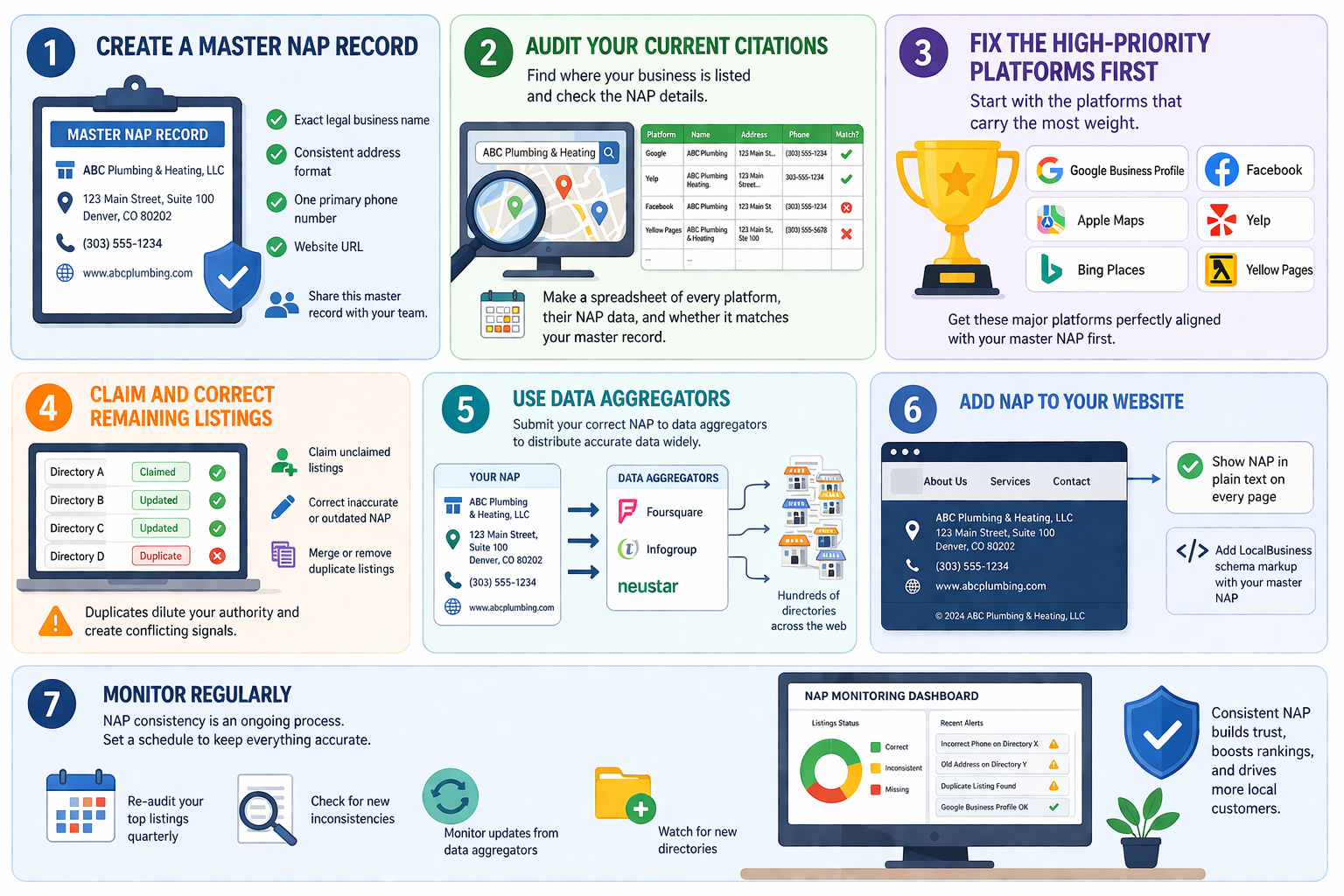
Step 1: Create a Master NAP Record
Before you touch a single listing, decide on your official, canonical NAP format. Write it down in a document and treat it as your single source of truth. This should include:
- Your exact legal business name (with consistent use of “&” vs. “and”, punctuation, suffixes like “LLC”)
- Your full address in a single standardized format (include or exclude suite numbers consistently, spell out “Street” or abbreviate to “St.” — pick one and never deviate)
- One primary phone number in one consistent format
- Your website URL
Share this master record with anyone on your team who manages online listings.
Step 2: Audit Your Current Citations
Now find out where your business is currently listed and what those listings actually say. You can do this manually, search Google for your business name combined with your old phone number or previous address or use dedicated tools (more on those below) that scan hundreds of directories at once and flag inconsistencies automatically.
Make a spreadsheet of every platform where you are listed, the current NAP data there and whether it matches your master record.
Step 3: Fix the High-Priority Platforms First
Do not try to fix everything at once. Start with the platforms that carry the most weight. Depending on your business, you can get started with, for example,
- Google Business Profile
- Apple Maps
- Bing Places
- ফেসবুক
- লিঙ্কডইন
- Yelp
- Yellow Pages
Get these major platforms perfectly aligned with your master NAP before moving on to smaller directories. These are the sources Google trusts most and references most frequently.
Step 4: Claim And Correct Remaining Listings
Work through your audit list platform by platform. Claim unclaimed listings, correct inaccurate NAP data and update anything outdated. Where you find duplicate listings on the same platform, merge or remove the extras. Duplicate listings dilute your authority and create conflicting signals.
Step 5: Use Data Aggregators
Data aggregators like Foursquare, Infogroup and Neustar distribute business information to hundreds of directories across the web. Submitting your correct NAP to these aggregators can help push accurate data to directories you would never be able to manually reach on your own.
Step 6: Add NAP to Your Website
Make sure your NAP is visible in plain text on your website, not embedded in an image (search engines can not read alt text). The most common placement is the footer, where it appears consistently on every page. Also, implement LocalBusiness schema markup with your master NAP to give search engines a clean, structured data signal about your business details.
Stap 7: Monitor Regularly
NAP consistency is not a one-time fix. Business details change. Data aggregators push updates that can overwrite your corrections. New directories pop up with auto-populated (and sometimes wrong) information. Set a quarterly reminder to re-audit your top listings and check for new inconsistencies.
Tools to Help You Manage NAP Consistency
Manually checking every directory is time-consuming. These tools make it significantly easier:
BrightLocal — One of the most popular local SEO platforms, BrightLocal’s Citation Tracker audits your NAP across the web, identifies inconsistencies, flags duplicate listings, and tracks citation accuracy over time. Particularly useful for single-location and multi-location businesses alike.
Moz Local — Syncs your business data across major data aggregators and directories, shows how complete and accurate your listings are and provides real-time monitoring for changes.
Yext — Enables centralized control over your listings across 50+ directories simultaneously. More expensive than other options, but powerful for businesses that need bulk NAP updates fast.
Whitespark — Specializes in local citation building and finding niche, industry-specific directories where your competitors are listed. Also provides manual citation building as a service.
For small businesses just starting, a manual audit combined with a free tool like GMB Everywhere is a solid first step. As you scale, investing in BrightLocal or Moz Local pays for itself quickly in time saved and rankings gained.
NAP Consistency And Social Proof: A Hidden Connection
Here is something that often gets overlooked in NAP discussions: consistent business information does not just influence search rankings, it directly affects how much customers trust you when they find you.
When a potential customer sees your business listed on Google, then looks you up on Yelp, then checks your Facebook page and the name, address and phone number match precisely across all three, that is a subtle but powerful signal of legitimacy. It tells them this is a real, organized, professional business. It lowers purchase hesitation.
On the flip side, when details do not match (an old address here, a slightly different business name there), that friction creates doubt. And in a world where customers have endless local alternatives at their fingertips, doubt drives them straight to your competitors.
This is exactly the space where tools like NotificationX come in.
While NAP consistency works behind the scenes to build trust with search engines, NotificationX works on the surface of your website to build trust directly with visitors (by showing real-time sales notifications, customer reviews, recent activity alerts and social proof popups that reassure visitors they’re in the right place).
Together, solid NAP hygiene and visible on-site social proof create a complete trust ecosystem: you get found more often, and you convert more of the visitors who land on your site.
NAP Consistency for Multi-Location Businesses
If you run more than one location, the complexity multiplies and so do the risks.
Each location needs its own distinct NAP, its own Google Business Profile and its own set of directory listings. Common mistakes in multi-location setups include using the same phone number across locations, inconsistent suite or unit numbering and listings that blend location details from different branches.
The solution is the same principle scaled up: a master NAP record for each location, a systematic audit of all listings for each one, and a central tracking document (or a tool like Yext) that lets you manage them all from one place.
Frequently Asked Questions About NAP Consistency
How long does it take to see results after fixing NAP inconsistencies?
It varies, but most businesses begin to see measurable improvements in local rankings within 60 to 90 days of completing a thorough NAP cleanup. Some improvements come sooner, especially after fixing the major platforms like Google Business Profile and Yelp.
Does NAP consistency still matter if I’m a service-area business without a public address?
Yes, but it works differently. Service-area businesses should follow Google’s guidelines for hiding their physical address while still maintaining consistent NAP where an address is published. Consistency in your business name and phone number still matters across all platforms.
What if I can’t edit a listing because I don’t have access to the account?
Most directories have a process for claiming or correcting unclaimed listings. For directories that are difficult to update directly, submitting corrections through data aggregators like Neustar or Foursquare can eventually push the correct data through.
Should I prioritize quantity or quality of citations?
Quality and accuracy come first, every time. A hundred listings with inconsistent NAP data do more harm than good. Build a smaller set of accurate, high-authority citations and expand from there.
Boost Your Local Business with NAP Consistency
NAP consistency will not make the headlines the way AI search or zero-click results do, but it is one of the quiet, foundational factors that separates local businesses that dominate search results from those that wonder why they can’t break through.
The good news is that it is entirely within your control. You do not need a big budget, a technical background, or an agency retainer to fix it. You need a master NAP document, a methodical audit, and the patience to work through your listings one platform at a time.
Get this right, and you take away one of the most common reasons Google does not trust your business enough to rank it. That trust, built quietly across dozens of directories, is what pushes your listing into the Local 3-Pack and in front of customers who are ready to buy before your competitors even get a look in.
Do not forget to আমাদের ব্লগে সাবস্ক্রাইব করুন for more informational content on local businesses. Join our ফেসবুক সম্প্রদায় to discuss the latest community trends and discussions.





 English
  Arabic
  Indonesian
  Spanish
  Bengali
  Portuguese
  German
  Dutch
Dutch  Russian
  Hindi
Hindi  French
  Japanese
  Chinese
  Vietnamese
  Malay
Malay