
People trust people. That is the short version of every report we read for this guide.
We analyzed 58 word-of-mouth marketing statistics from Nielsen, McKinsey, BrightLocal, Wharton, SurveyMonkey, Reddit and more. Some numbers are fresh from 2026. Others come from classic studies that still shape how marketers think. Together, they show one clear pattern.
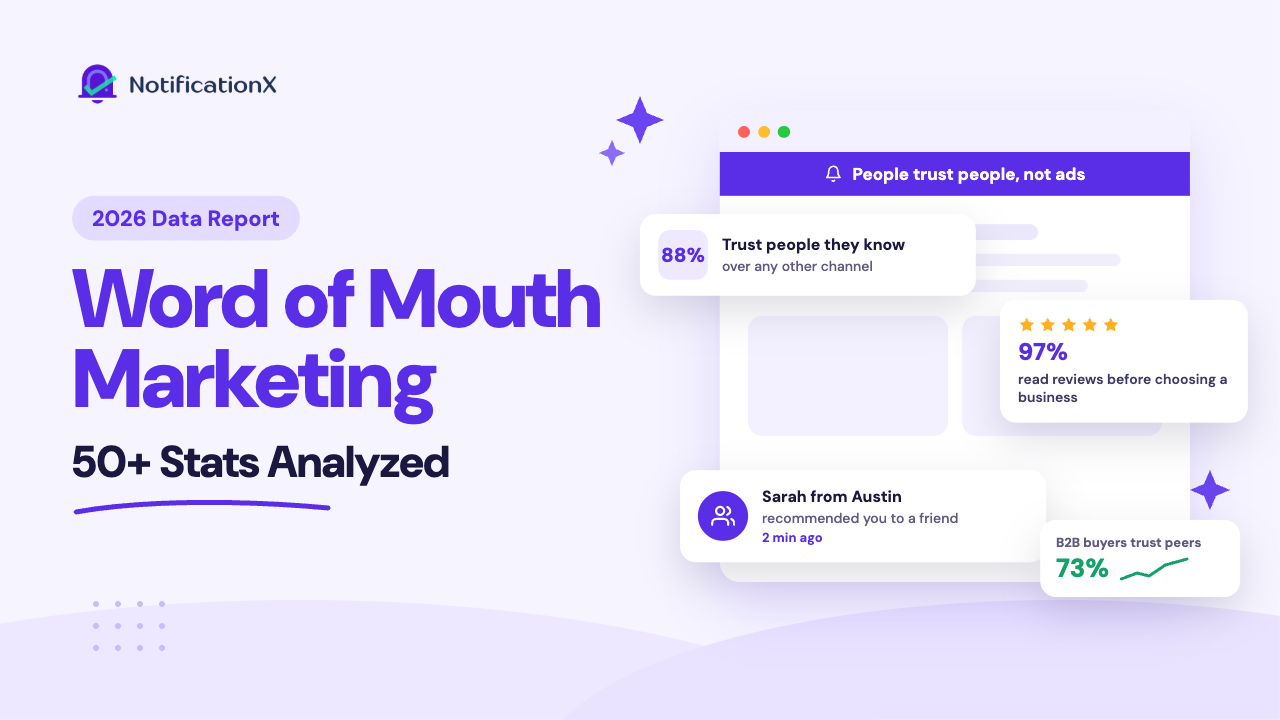
Word of mouth marketing is still the most trusted way to win a customer. But how it spreads has changed. It now lives in customer reviews, AI answers, peer communities and short videos.
In this blog, you will find the stats, what they mean, and how to turn them into conversions on your own website with social proof.
How we built this list: We reviewed reports from Nielsen, McKinsey, BrightLocal, Spiegel Research Center, Sprout Social, Bazaarvoice, SurveyMonkey, Reddit, Wharton and WOMMA. Most stats come from 2024 to 2026. We also kept a few classic studies from 2010 to 2017 because marketers still cite them, and we show the year next to every stat so you can judge each one. These word of mouth advertising statistics link to the original source wherever we could find it.
At a Glance: Word of Mouth Marketing Statistics 2026
| What we measured | Number | Source | Year |
| Purchases where word of mouth is the primary factor | 20% to 50% | McKinsey | 2010 |
| US consumers who most trust recommendations from people they know | 89% | Nielsen | 2021 |
| Consumers who read reviews for local businesses | 97% | BrightLocal | 2026 |
| Consumers who use AI tools for local recommendations | 45%, up from 6% | BrightLocal | 2026 |
| B2B decision makers who trust peer recommendations | 73% | SurveyMonkey and Reddit | 2026 |
| Extra lifetime value of a referred customer | 16% | Wharton study | 2011 |
What Is Word of Mouth Marketing?
Word of mouth marketing (also called WOM marketing) happens when customers talk about your brand to other people. It can happen over dinner, in a Slack group, in a Google review or in a TikTok video.
You cannot buy it directly. But you can earn it, encourage it and show it off. Referral programs, review requests and social proof notifications all help word of mouth travel faster.
Today, much of it is electronic word of mouth (eWOM): reviews, social posts, forum threads and creator videos. A large part also happens in dark social, such as DMs, group chats and email. Analytics tools often label that traffic as direct. You cannot see most of these conversations. But you can show their results on your own site.
Why Word of Mouth Matters More in 2026
Buyers see more ads and more AI-generated content than ever. So they look for proof from real people before they act. Three shifts stand out this year:
- AI tools now recommend businesses. These tools lean on reviews and peer talk to form answers.
- Buyers research alone first. Most finish their homework before they ever talk to a brand.
- Old proof is losing its pull. Shoppers want fresh reviews, not ones from last year.
Every stat below points back to these three shifts.
General Word of Mouth Marketing Statistics
Word of mouth sits behind a huge share of what people buy. Yet very few brands manage it well. These word of mouth statistics show the scale.
1. Word of mouth is the primary factor behind 20% to 50% of all purchasing decisions. Its pull is strongest for expensive and first-time purchases (McKinsey, 2010).
2. Word of mouth sparked by marketing drives more than twice the sales of paid advertising in categories like skincare and mobile phones (McKinsey, 2010).
3. Word of mouth that comes from direct product experience makes up 50% to 80% of all word of mouth in a category (McKinsey, 2010).
4. Influential people create three times more word-of-mouth messages than others. Each of their messages has four times more impact on a purchase (McKinsey, 2010).
5. Word of mouth drives about $6 trillion in yearly global consumer spending. It is estimated to account for 13% of all consumer sales (WOMMA, 2014).
6. In the mobile phone market, word of mouth could raise market share by as much as 10%, or cut it by 20%, within two years (McKinsey, 2010).
7. One offline word-of-mouth impression drives at least 5 times more sales than one paid media impression (WOMMA, 2014).
8. Offline conversations drive about two-thirds of the sales impact of word of mouth, and online conversations drive about one-third (WOMMA, 2014).
9. 64% of marketing executives say word of mouth is more effective than traditional marketing (AMA and WOMMA, 2014).
10. Yet only 6% rate their company as advanced at word of mouth marketing (AMA and WOMMA, 2014).
What it means: Word of mouth is massive, but most brands leave it to chance. That gap is your opportunity.
Trust and Recommendation Statistics
Trust is the engine of word of mouth. People believe friends, family and peers far more than they believe ads.
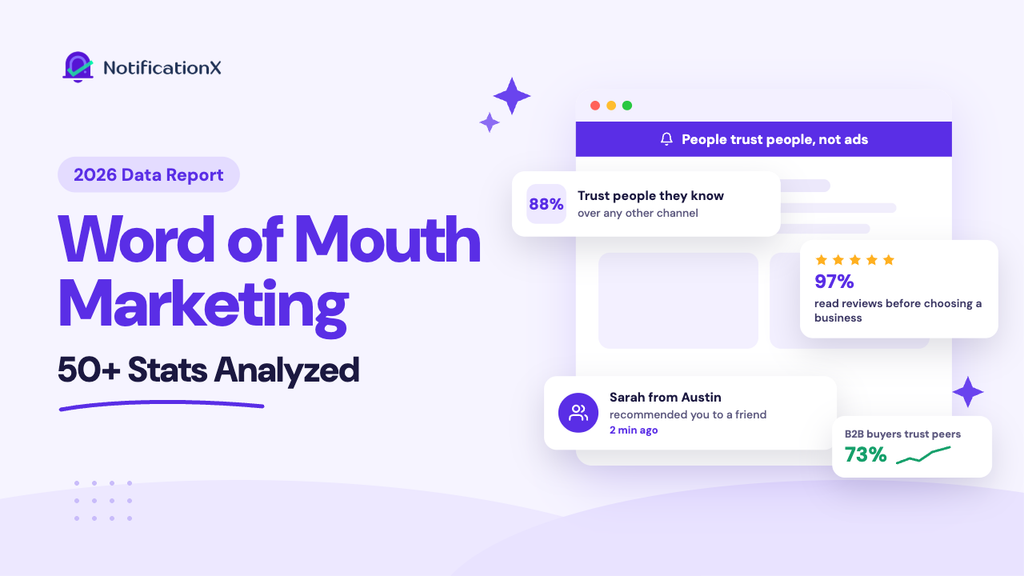
11. 88% of people around the world most trust recommendations from people they know. In the US, the Nielsen figure is 89% (Nielsen, 2021).
12. In the US, recommendations from people they know and emails people signed up for are almost 2x more likely to drive action than other channels (Nielsen, 2021).
13. A high-impact recommendation, like a relevant tip from a trusted friend, can be up to 50 times more likely to trigger a purchase than a low-impact one (McKinsey, 2010).
14. 77% of consumers named advice from friends and family as the most persuasive source of new product information, in a global survey of 29,000 people (Nielsen, 2013).
15. Only about 8% to 10% of consumers are what McKinsey calls influentials, people others trust for their know-how (McKinsey, 2010).
16. 49% of US consumers now trust online reviews as much as peer recommendations from people they know, up from 42% in 2025 (BrightLocal, 2026).
17. 40% of consumers trust AI platforms for business recommendations. 42% trust them as much as traditional reviews (BrightLocal, 2026).
What it means: Customer trust is earned through other people. Your job is to make that peer voice easy to find and hard to miss.
Online Review and Social Proof Statistics
Online reviews are word of mouth at scale. These online review statistics show that shoppers now read more, expect more and act faster on what they read. Most figures below come from the BrightLocal Local Consumer Review Survey 2026, a poll of 1,002 US adults.
18. 97% of consumers read reviews for local businesses (BrightLocal, 2026).
19. 41% of consumers always read reviews when they look for a business. That is up from 29% a year earlier (BrightLocal, 2026).
20. The average consumer uses six different review sites before picking a business (BrightLocal, 2026).
21. 85% of consumers are more likely to use a business after reading positive reviews. Negative reviews put off 77% (BrightLocal, 2026).
22. 93% of consumers have bought something after reading reviews. 27% spent more than $1,000 (BrightLocal, 2026).
23. 54% of consumers visit the business website after reading positive reviews. In 2019, it was 32% (BrightLocal, 2026).
24. 47% of consumers will not use a business with fewer than 20 reviews (BrightLocal, 2026).
25. 74% of consumers only care about reviews written in the last three months (BrightLocal, 2026).
26. 31% of consumers will only use a business rated 4.5 stars or higher, up from 17%. 68% need at least 4 stars, up from 55% (BrightLocal, 2026).
27. 89% of consumers expect owners to reply to reviews. 80% are likely to choose a business that replies to every review (BrightLocal, 2026).
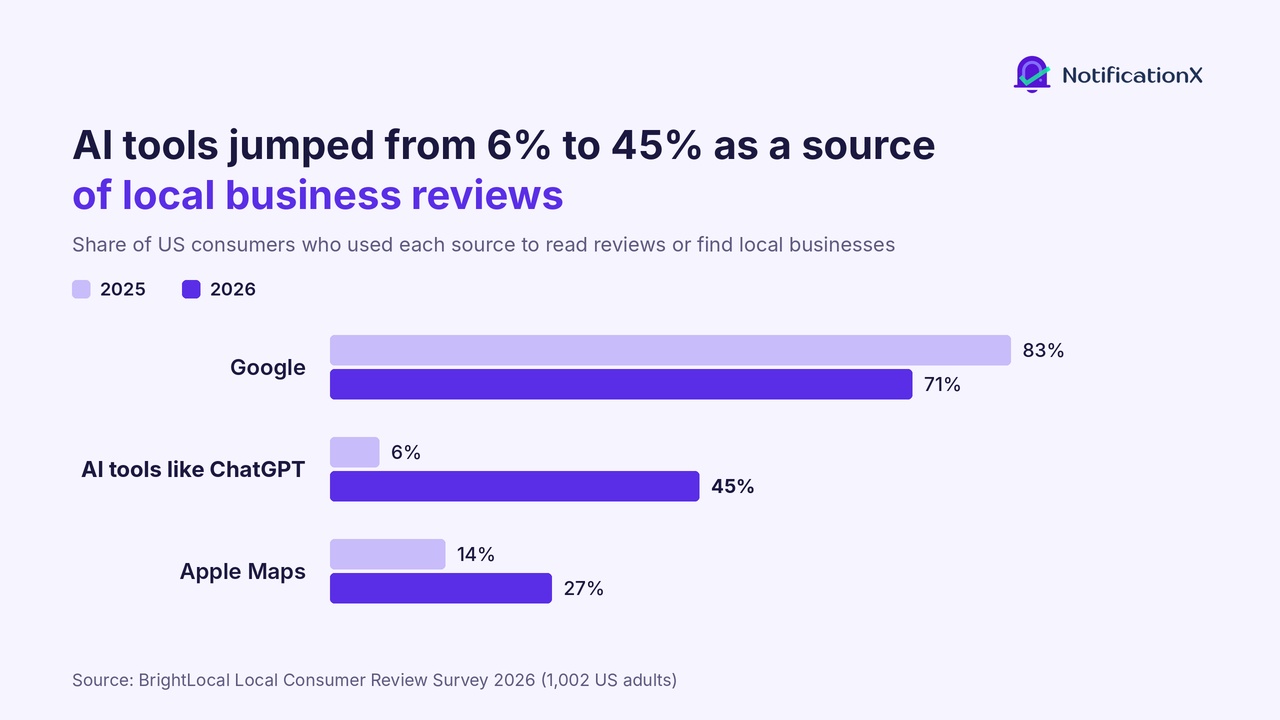
28. 45% of consumers now use AI tools like ChatGPT for local recommendations, up from 6%. Google’s share as a review source fell from 83% to 71% in the same survey (BrightLocal, 2026).
29. 82% of consumers read AI generated review summaries. 23% would decide based on the summary alone (BrightLocal, 2026).
30. 28% of consumers will always write a review if a business asks, up from 16% in 2025 (BrightLocal, 2026).
31. A product with five reviews is 270% more likely to be bought than one with no reviews (Spiegel Research Center, 2017).
32. Purchase likelihood peaks below a perfect score. Ratings between 4.0 and 4.7 stars tend to win, as a flat 5.0 can look too good to be true (Spiegel Research Center, 2017).
33. Verified buyer badges can raise purchase likelihood by 15% (Spiegel Research Center, 2017).
What it means: Customer reviews must be fresh, plentiful and visible. A good review on Google is only half the job. You also need to show it on your site, where more than half of readers go next. Learn how in our guide to real-time social proof examples.
Social Media, UGC and Influencer Word of Mouth Statistics
Social platforms turn one opinion into thousands of views. User generated content (UGC) and video now carry word of mouth further than any single chat. For younger buyers, Gen Z word of mouth now starts on social feeds.
34. 76% of consumers say social media content influenced a purchase in the past six months. For Gen Z, the figure is 90% (Sprout Social, 2025).
35. 41% of Gen Z go to social platforms first when they look for information, ahead of search engines at 32% (Sprout Social, 2025).
36. 37% of consumers go to social media first for product reviews and recommendations (Sprout Social, 2025).
37. About 65% of shoppers rely on user generated content, such as ratings, reviews, photos and videos, when they buy (Bazaarvoice, 2024).
38. 80% of Gen Z shoppers say UGC is crucial to their buying decisions (Bazaarvoice, 2024).
39. YouTube, Instagram and TikTok are all gaining ground as places people find reviews. 36% of consumers value a review that comes with an appealing photo or video (BrightLocal, 2026).
40. 86% of shoppers engage with creator content before they make a buying decision (Bazaarvoice, 2024).
What it means: Small creators and real customers beat polished ads. Collect videos and photos from buyers, and reuse them across your site. For more ideas, see these FOMO marketing strategies.
Referral Marketing Statistics
Referrals are word of mouth with a tracking link. These referral marketing statistics show that referred buyers are not just cheaper to win. They are also better customers.
41. A referred customer has at least 16% higher lifetime value than a similar customer who was not referred (Journal of Marketing, 2011).
42. Referred customers leave about 18% more slowly than other customers (GfK MIR, 2013).
43. In the same bank study, referred customers were about 25% more profitable at first, though the gap narrowed over time. A reward of 25 euros per referral returned about 60% over six years, based on a 40 euro gap in lifetime value (GfK MIR, 2013).
44. Referral traffic converts at 2.5% to 3.5%. Paid social traffic converts at only 0.5% to 1% (Elogic Commerce via Shopify, 2026).
45. Deodorant brand Wild now gets about 25% to 30% of its sales through referrals (Shopify, 2026).
46. Paid channel customer acquisition costs rose 40% from 2023 to 2025. The average cost to win an ecommerce customer is now $78 (UpCounting via Shopify, 2026).
What it means: As ad costs rise, referrals look more like a must than a nice extra. Ask happy buyers to share, and reward them for it.
B2B Word of Mouth Statistics
B2B word of mouth is just as strong as in retail. Business buyers trust peers far more than vendor claims, and they do most of their research alone.
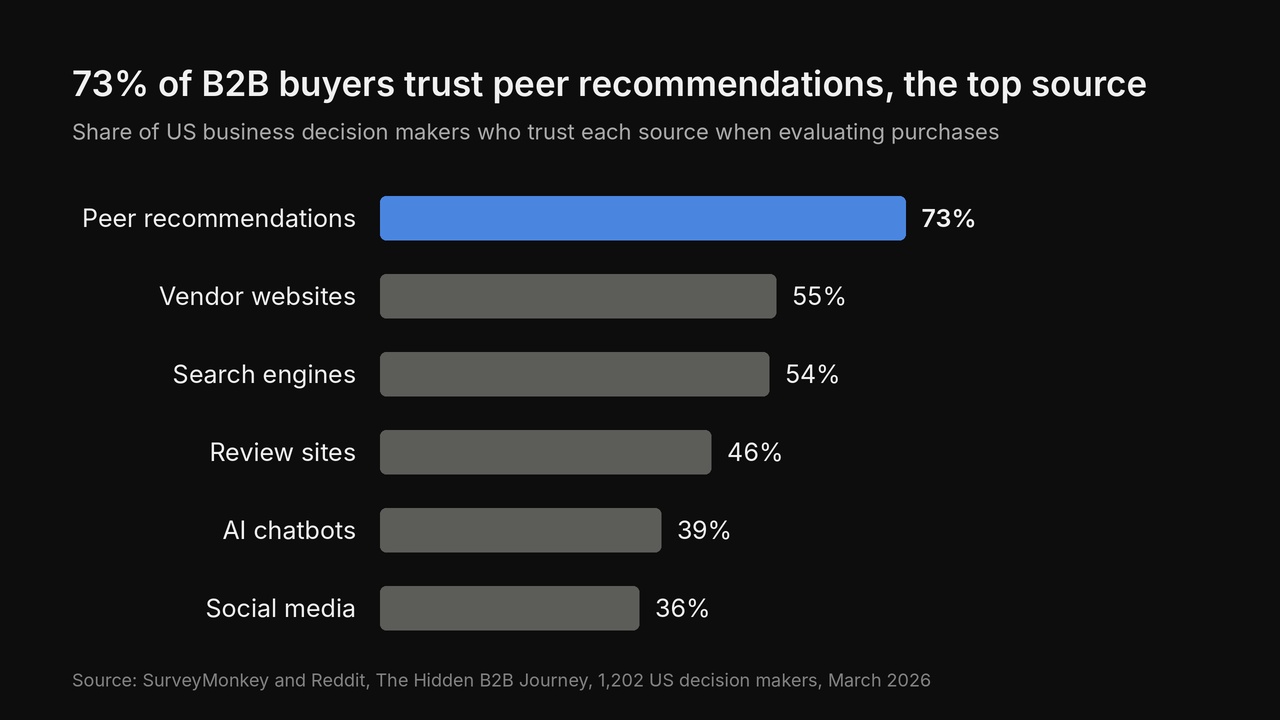
47. 73% of B2B decision makers trust peer recommendations. No other source comes close, and AI chatbots rank near the bottom (SurveyMonkey and Reddit, 2026).
48. 83% of B2B decision makers research on their own before they ever speak to sales (SurveyMonkey and Reddit, 2026).
49. 55% of decision makers struggle to know which sources to trust. 48% find it hard to locate real user testimonials (SurveyMonkey and Reddit, 2026).
50. 70% of decision makers have used social media at least once to research a business purchase (SurveyMonkey and Reddit, 2026).
51. Only 23% of decision makers use Reddit for research. Among those who do, 77% go there for reviews and testimonials (SurveyMonkey and Reddit, 2026).
What it means: B2B buyers want proof from people like them. Put testimonials, reviews and usage numbers on your pricing and product pages, not just your homepage.
Review Response and Brand Advocacy Statistics
Great experiences create fans. How you handle reviews, good and bad, shapes what people say next. These brand advocacy stats show what buyers expect.
52. 42% of consumers are unlikely to use a business that never replies to its reviews (BrightLocal, 2026).
53. 50% of consumers are put off by generic or templated review replies (BrightLocal, 2026).
54. 19% of consumers expect a reply on the same day they post a review, up from 6% a year earlier. 81% expect one within a week (BrightLocal, 2026).
55. 70% of consumers have made a purchase they regretted after reading reviews. 14% regretted spending more than $1,000 (BrightLocal, 2026).
56. 97% of consumers think businesses should face a penalty for fake reviews (BrightLocal, 2026).
57. 45% of consumers left a Google review in the past year, ahead of Facebook at 34% and Yelp at 24% (BrightLocal, 2026).
58. 94% of consumers are open to writing reviews, and 69% wrote at least one in the past year. 60% wrote about a positive experience, while 29% wrote about a negative one (BrightLocal, 2026).
What it means: Most customers are happy to speak up. Deliver a great product, reply to every review quickly and personally, and ask for feedback at the right moment.
What the Numbers Say: Our Analysis
After going through all 58 stats, five big lessons stand out.
1. Trust Beats Reach
An ad can reach millions. But 88% of people still trust recommendations from people they know over any other channel. A small message from a real customer often does more than a big campaign.
2. Fresh Proof Wins
74% of consumers only care about reviews from the last three months. 41% now read reviews every single time. Old testimonials are losing power fast. You need a steady flow of new customer reviews.
3. Reviews Now Feed AI
45% of consumers use AI tools for local recommendations. Those tools often draw on reviews, listings and community discussions to form answers. So word of mouth now shapes what AI says about you, too.
4. Your Website Is the Second Stop
54% of people visit a business website after reading good reviews. Most still want more proof: 66% keep researching after a positive review, while only 34% are ready to buy. If your site does not show the same social proof, the trail goes cold. This matters most for small businesses: BrightLocal found that only 40% of local businesses have a dedicated website. It is one of the clearest word of mouth statistics for small business owners.
5. Most Brands Leave It to Chance
In a 2014 AMA and WOMMA survey, only 6% of marketers rated their company as advanced at word of mouth. Yet referred customers stay longer and are worth more. The brands that turn word of mouth into a system will pull ahead.
How to Turn Word of Mouth Into Website Conversions With NotificationX
Word of mouth brings people to your website. Your website then has to close the deal. The best way is to show visitors the same proof that brought them there.
NotificationX is a social proof and FOMO marketing plugin for WordPress. It turns real customer activity into small, eye-catching social proof notifications. Here is how to match it to the stats above. These are practical word of mouth marketing examples for any WordPress site.
1. Show Fresh Google Reviews on Your Site
74% of buyers want recent reviews. NotificationX can pull your latest Google Reviews and show them as live popups. You can sort them by Newest (or Most Relevant), so visitors always see fresh proof. Note that Google Reviews is a NotificationX PRO feature.

👉 Learn more: How to Configure Google Reviews With NotificationX?
2. Display WooCommerce Product Reviews
A product with five reviews is far more likely to sell than one with none. Show every new WooCommerce or ReviewX review as a notification on product and shop pages.
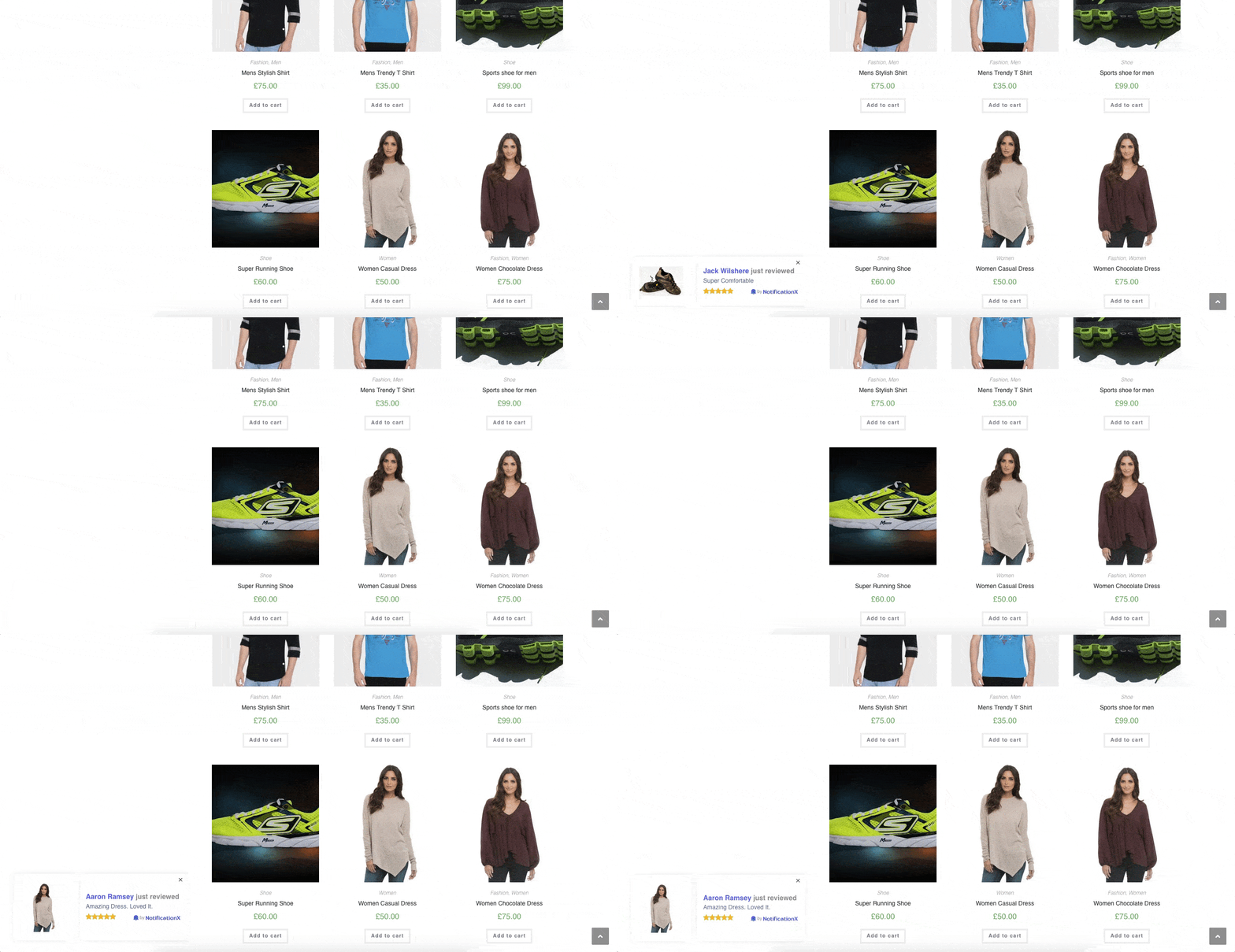
👉 Learn more: How To Display WooCommerce Reviews For Products In NotificationX?
3. Show Real-Time Sales Notifications
People follow what others buy. Live sales alerts show real purchases from WooCommerce, Easy Digital Downloads and more. Each alert acts like a quiet recommendation from another buyer.
👉 Learn more: How to Use Sales Notification in NotificationX?
4. Show Your YouTube Proof
Social content shapes buying decisions: 90% of Gen Z say it influenced a purchase in the past six months. NotificationX can show your YouTube channel and video activity, such as subscribers, views and likes, in a light popup.
👉 Learn more: How To Display YouTube Video Activities Popups With NotificationX?
5. Promote Your Referral Offer With a Notification Bar
Referred customers are worth more. Use a Notification Bar to tell visitors about your refer-a-friend reward. Add a countdown to make the offer feel urgent.
6. Highlight Growth Milestones
Big numbers build trust. Use Growth Alerts to show how many people bought, enrolled or signed up, with data from WooCommerce, Easy Digital Downloads, LearnDash or Tutor LMS.
👉 Learn more: How To Configure NotificationX Growth Alert?
7. Keep Your Social Proof Real
97% of consumers think businesses should face a penalty for fake reviews. So only show proof that is real. Connect NotificationX to real data sources, such as WooCommerce orders, Google Reviews and form submissions, so every alert reflects something that happened.
Want proof that this works? See how Barn2 turned prospects into customers with NotificationX.
How to Measure Word of Mouth Marketing
You cannot track every conversation. But knowing how to measure word of mouth helps you prove it works. Track these signals:
- Referral tracking: give each customer a unique link or code, and count the sales it brings.
- A “How did you hear about us?” field: add it to your checkout or sign-up form.
- Net Promoter Score (NPS): ask customers how likely they are to recommend you, on a scale of 0 to 10.
- Branded search and direct traffic: a steady rise often means people are talking about you.
- Review volume and rating: track how many new reviews you get each month and your average stars.
- Notification analytics: NotificationX PRO shows views, clicks and click-through rate for your alerts, so you can see which proof works best.
Turn Word of Mouth Into Your Strongest Growth Channel
The numbers are clear. People trust people. They read fresh reviews, ask peers, check AI answers and then visit your website for one last proof point.
You cannot control every conversation. But you can make sure good word of mouth shows up at the exact moment a visitor decides. Start with your reviews, your sales activity and your happiest customers. Then let NotificationX put that proof in front of every visitor.
If you found this blog helpful, share your thoughts with our Facebook community. You can also subscribe to our blog for more tips, guides and the latest WordPress updates.




 English
 Arabic
 Indonesian
 Spanish
 Portuguese
 German
 Dutch
 Russian
 Hindi
 French
 Japanese
 Chinese
 Vietnamese
 Malay