
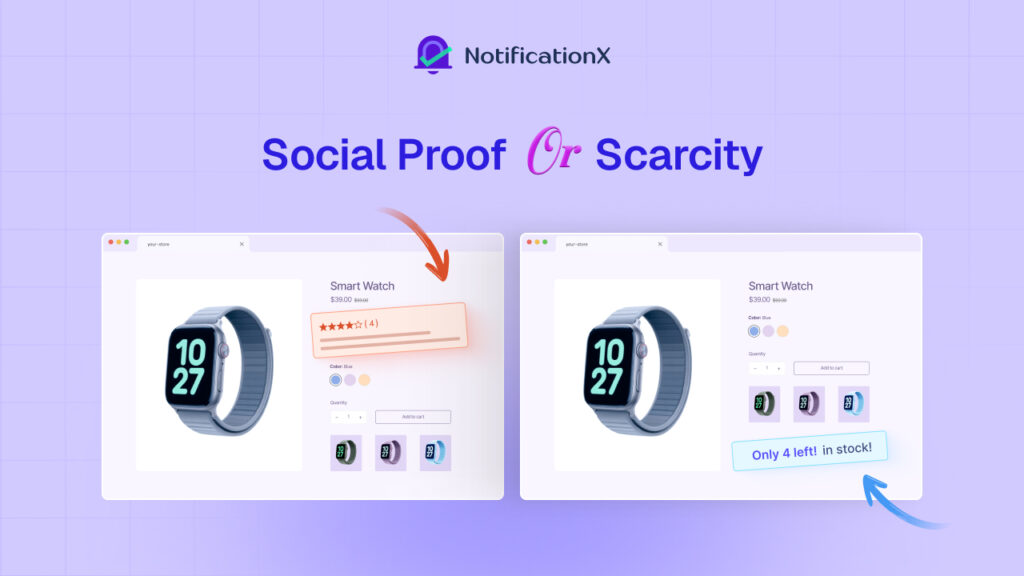
In the digital marketplace where consumers encounter over 10,000 brand messages daily, marketers face a critical question: Should you utilize social proof or scarcity to drive conversions? The answer is not straightforward, both psychological triggers deliver powerful results, but their effectiveness varies dramatically based on your product type, audience and implementation strategy.
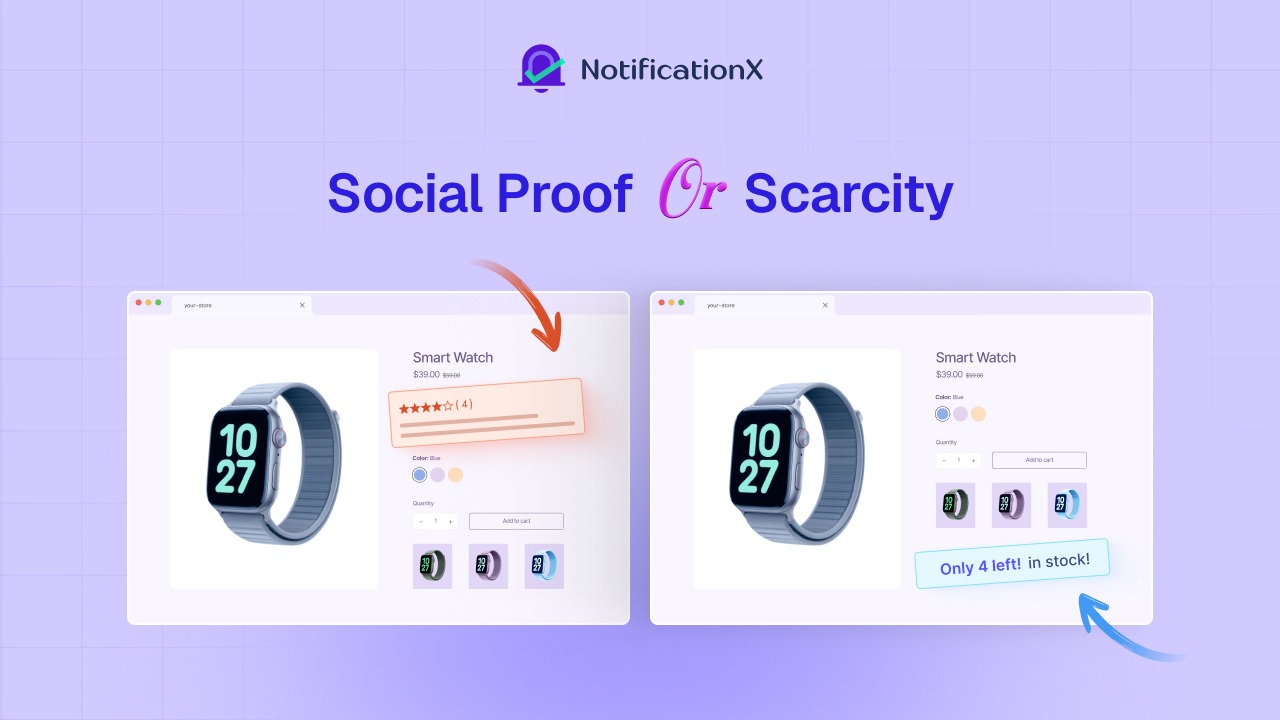
This blog post has real-world conversion statistics to help you make informed decisions about which psychological principle will maximize your marketing ROI.
Quick Summary / TL;DR
| If You Want To | Use This | Expected Impact | Time Required |
| Build long-term trust and credibility | Social Proof (Reviews & Testimonials) | 270% increase in purchase likelihood | 2-4 weeks to collect initial reviews |
| Create immediate urgency for time-sensitive offers | Time-Based Scarcity | 98% conversion boost with real-time notifications | 1-3 days for implementation |
| Increase perceived value of luxury/hedonic products | Supply-Based Scarcity (Limited Edition) | Highest effect size for exclusive items | 1-2 weeks for campaign setup |
| Boost conversions for everyday essentials | Demand-Based Scarcity (“Popular Item”) | Most effective for utilitarian products | 2-5 days for setup |
| Maximize revenue per customer | Combined Social Proof Strategy | 62% revenue increase per customer | 3-6 weeks for full implementation |
| Drive immediate purchases from new visitors | FOMO Marketing (Scarcity + Social Proof) | 69% of millennials purchase within 24 hours | 1 week for integration |
What Is Social Proof And Why Is It Important?
Social proof is a psychological and social phenomenon where people conform to the actions and opinions of others to guide their own behavior. First invented in 1984, the concept has evolved significantly in the digital age, where consumers’ trust and credibility of businesses are based on social engagement and authentic customer experiences.
In modern marketing, social proof works through customer reviews, testimonials, user-generated content, influencer marketing, trust badges, case studies and social media validation. It operates on a fundamental principle: if others trust a brand, new customers are more likely to trust it too.
Why Social Proof Is Important?
Social proof has become important in the digital age. This is not a theoretical decision; it has some data that backs this up. Here are some of the statistics that prove why social proof is important.
- 92% of consumers hesitate to purchase when no reviews are available, making reviews virtually mandatory for online sales.
- 88% of consumers trust user reviews as much as personal recommendations, fundamentally altering how credibility transfers online.
- Products with reviews show 270% higher purchase likelihood compared to products without any reviews.
- Consistent social proof can increase revenue by 62% per customer, reflecting both higher purchase values and improved retention.
Real-World Examples of Social Proof
Customer Reviews & Ratings: Amazon’s review system, where 97% of consumers say online reviews help them decide what to buy.
Video Testimonials: Brands like Casper and Airbnb use video testimonials, which increase conversion rates by 80% compared to text-only testimonials.
User-Generated Content: Fashion brands like Glossier and 82°E showcase customer photos, with UGC increasing web conversion rates by 29%.
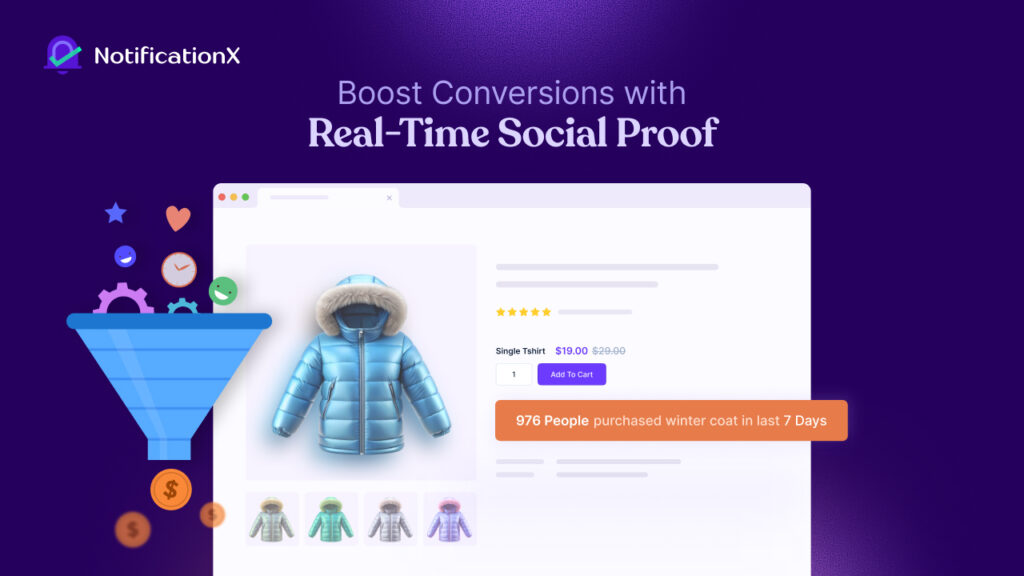
Real-Time Activity Notifications: eCommerce sites displaying “Someone in Austin just bought this” messages, which boost conversions by 98%.
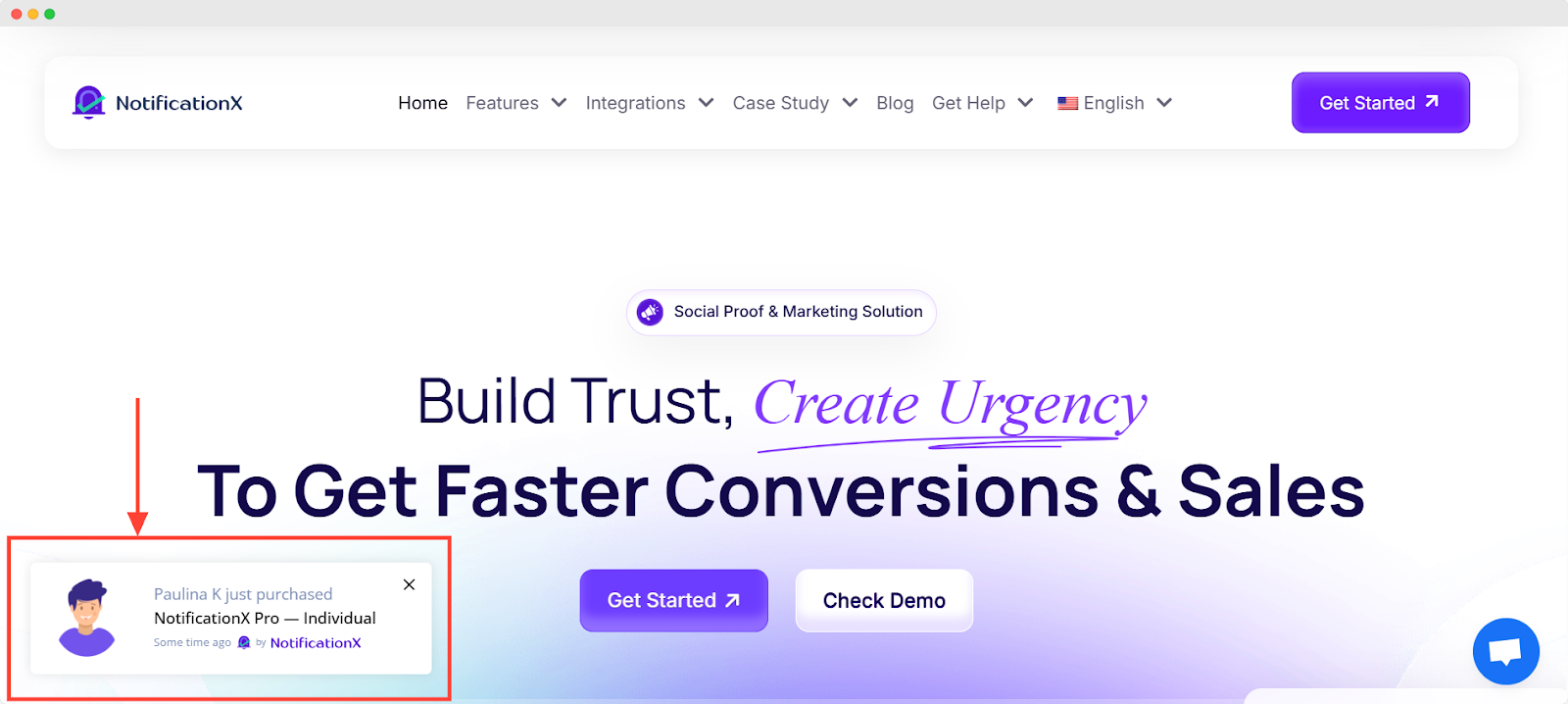
Trust Badges & Certifications: Security seals and industry certifications, with 50% of consumers finding trust badges reassuring.
Pros And Cons of Social Proof
| Pros | Cons |
| ✅ Builds Long-Term Trust: Creates sustainable credibility that compounds over time | ❌ Requires Time to Accumulate: New businesses may struggle with limited reviews initially |
| ✅ High Conversion Impact: Increase in purchase likelihood with 5+ reviews | ❌ Maintenance Required: Regular maintenance is required because outdated or old reviews might not be that impactful. |
| ✅ Authentic & Transparent: 84% of consumers trust brands using genuine UGC in campaigns | ❌Quality Control Challenges: Need systems to collect, manage, and display reviews effectively |
| ✅ Works Across All Product Types: Effective for both B2B and B2C, luxury and everyday items | |
| ✅ Multiplier Effect: Works synergistically with other marketing efforts, improving email CTR. | |
| ✅ Cost-Effective: Once systems are established, reviews generate continuous value |
What Is Scarcity in Marketing And Why Is It Important?
Scarcity marketing is a psychological strategy based on the principle that people assign higher value to items or opportunities that are limited in availability. Rooted in behavioral economics and Daniel Kahneman’s Nobel-winning research on Loss Aversion, scarcity marketing utilizes the fact that the psychological pain of losing something is approximately twice as intense as the pleasure of gaining it.
When supply decreases or appears to decrease, perceived value increases. This triggers the Fear of Missing Out (FOMO) and compels consumers to act quickly before the opportunity disappears.
Types of Scarcity in Marketing
There are some particular types of scarcity in marketing that you should know before you jump into why it is important to know. Here are the types mentioned below:
1. Supply-Based Scarcity: Limited production or distribution (e.g., “Limited Edition,” “Only 50 Made”)
- Most effective for experiential products and luxury items
- Associates products with exclusivity and status
- Examples: Ferrari’s intentional production limits, limited-edition sneaker drops
2. Demand-Based Scarcity: Depleted stock due to high demand (e.g., “Almost Sold Out,” “High Demand”)
- Most effective for everyday essential products
- Signals popularity and quality
- Examples: “Only 3 left in stock” notifications, bestseller badges
3. Time-Based Scarcity: Limited availability within specific timeframes (e.g., “Flash Sale Ends in 2 Hours”)
- Greatest effect on high-involvement products
- Creates urgency through deadlines
- Examples: Flash sales, seasonal offers, cart expiration timers
Why Scarcity Is Important?
Scarcity marketing drives measurable business results. As people tend to FOMO about particular products they look into, this has some significant importance to it. Here are some data-backed decisions that prove why it is important.
- 69% of millennials make purchases due to FOMO within a year
- FOMO marketing tactics can increase conversion rates by 2x to 3x when implemented correctly.
- 60% of people experiencing FOMO make purchases within 24 hours, demonstrating the immediate impact.
- Supply-based scarcity shows the highest overall effect size in meta-analysis research, followed by time-based scarcity.
Real-World Examples of Scarcity Marketing
Supply-Based Scarcity: Supreme’s limited product drops, Disney’s vault strategy for movies, Nike SNKRS exclusive releases.
Demand-Based Scarcity: Amazon’s “Only 2 left in stock” notifications, Booking.com’s “Only 1 room left at this price”

Time-Based Scarcity: Ticketmaster’s cart reservation timers, flash sales on eCommerce platforms, seasonal Starbucks menu items.
Dynamic Pricing Scarcity: Airline tickets that increase in price as inventory depletes or as departure dates approach
Pros and Cons of Scarcity Marketing
| Pros | Cons |
| ✅Immediate Action: Creates urgency that shortens sales cycles dramatically | ❌Negative Customer Experience: Aggressive tactics can feel manipulative and damage relationships |
| ✅High Short-Term Impact: Can increase conversions by 98% with real-time scarcity notifications | ❌Scarcity Fatigue: Overuse makes consumers immune; “everything on sale” means nothing is special |
| ✅Taps into Loss Aversion: 2x more powerful than gain-focused messaging | ❌Ethical Concerns: Must be authentic; artificial scarcity is considered a “dark pattern.” |
| ✅Works Quickly: Can be implemented and show results within days | |
| ✅Increases Perceived Value: Scarcity naturally elevates product desirability | |
| ✅Effective Across Channels: Works in email, web, mobile, and physical retail |
Social Proof Or Scarcity: What Marketers Should Choose?
The debate between social proof and scarcity is not about choosing one over the other; it is about understanding when each strategy delivers optimal results and how they can work simultaneously.
The Strategic Framework
Research from the comprehensive meta-analysis reveals that effectiveness varies significantly based on several factors:
Product Type Matters: Supply-based and time-based scarcity show the most substantial effects for luxury items and experiential purchases, whereas demand-based scarcity has the most significant effects for everyday essentials. Social proof, conversely, demonstrates consistent effectiveness across all product categories.
Brand Familiarity Influences Strategy: For less familiar brands, the effects of scarcity are stronger than for well-known brands. Social proof is still important for building trust, no matter how recognized the brand is. Overall, scarcity has a bigger impact on lesser-known brands compared to established ones.
Visibility Environment: Supply-based and time-based scarcity work best in highly visible environments where consumers are likely to be seen with the product, enhancing the status and exclusivity appeal.
Customer Journey Stage: Social proof excels at building foundational trust and credibility (awareness and consideration stages), while scarcity drives immediate action (decision and purchase stages).
When to Use Social Proof
Best for:
- Building long-term brand credibility and trust
- Overcoming skepticism in new visitors
- B2B sales with longer consideration cycles
- Complex or high-risk purchases requiring validation
- Improving organic search visibility (reviews boost SEO)
- Establishing authority in crowded markets
- eCommerce products across all categories
- Service-based businesses require trust
When to Use Scarcity
Best for:
- Creating immediate urgency for time-sensitive offers
- Launching limited-edition or exclusive products
- Clearing excess inventory strategically
- Driving action during promotional periods
- High-involvement product purchases
- Luxury and hedonic products emphasizing exclusivity
- Experiential offerings (events, travel, dining)
- Flash sales and limited-time campaigns
Comparison Table: Social Proof vs. Scarcity
| Decision Factor | Choose Social Proof | Choose Scarcity | Use Both |
| Brand Stage | New businesses building trust | Established brands with credibility | Growth-stage companies |
| Product Type | All categories, especially B2B | Luxury items or utilitarian basics | High-value items |
| Customer Journey Stage | Awareness & Consideration | Decision & Purchase | Full funnel optimization |
| Sales Cycle Length | Long cycle (weeks/months) | Short cycle (hours/days) | Medium cycle (days/weeks) |
| Primary Goal | Build lasting credibility | Drive immediate action | Maximize conversions |
| Risk Tolerance | Low risk approach | Higher risk if misused | Balanced approach |
| Implementation Timeline | 2-6 weeks to see results | 1-7 days to see results | Phased rollout |
| Sustainability | Highly sustainable long-term | Best for campaigns/launches | Strategic combination |
| Product Category | Complex/ high-consideration | Exclusive or time-sensitive | Experiential purchases |
| Target Audience Familiarity | Unknown to your brand | Already aware of you | Mixed audience |
| Inventory Constraints | No constraints | Real limited stock | Controlled releases |
| Budget Available | Limited (organic strategy) | Moderate (campaign-focused) | Higher budget |
Implementation Difficulty Comparison Table
Every strategy has difficulties when implemented properly. Here is the comparison table for marketers to choose between scarcity and social proof, helping them better understand what to prioritize and how.
| Implementation Aspect | Social Proof | Scarcity Marketing |
| Technical Complexity | Medium – Requires review of collection systems, API integrations | Low to Medium – Can be as simple as countdown timers or as complex as real-time inventory feeds |
| Initial Setup Time | 2-6 weeks (collecting initial reviews) | 1-7 days (implementing scarcity elements) |
| Ongoing Maintenance | High – Continuous review collection, moderation, response management | Medium – Monitor authenticity, adjust scarcity parameters |
| Cost Investment | Low to Medium – Review software ($50-500/month), incentives for reviewers | Low – Mostly technical implementation, minimal ongoing costs |
| Risk of Backfire | Medium – Negative reviews visible, but manageable with response strategy | High – Fake scarcity destroys trust immediately and permanently |
| Authenticity Requirement | High – Must be genuine customer feedback (95% detect fakes) | Critical – Must reflect real constraints; consumers verify scarcity claims |
| Expertise Required | Medium – Customer success, reputation management skills | Low to Medium – Marketing psychology, ethical implementation, understanding |
| Scalability | High – Systems scale easily once established | High – Digital scarcity scales infinitely |
| Measurement Complexity | Medium – Track review volume, ratings, conversion correlation | Low – Direct A/B testing shows clear conversion impact |
| Resource Requirements | Ongoing customer outreach, review monitoring, and response time | Initial campaign setup, periodic validation of scarcity claims |
What Are the Common Mistakes of Social Proof And Scarcity?
Even though each of these strategies creates the possibility of high conversion rates, there are still some common mistakes that marketers can make while implementing them on their website. Here are some of the common mistakes that are mentioned.
Social Proof Implementation Mistakes
Social proof can increase trust. But while implementing, some common mistakes can totally derail the strategy. Here are some of the common mistakes of the social proof marketing strategy.
1. Using Fake or Unverifiable Testimonials
95% of consumers can detect inauthentic reviews and fake testimonials destroy trust instantly. Always use real customer feedback with verifiable sources.
2. Displaying Only Perfect 5-Star Reviews
Research shows purchase likelihood peaks at 4.2-4.5 stars. Perfect ratings trigger skepticism. Include authentic feedback with minor criticisms to enhance credibility.
3. Neglecting Review Recency
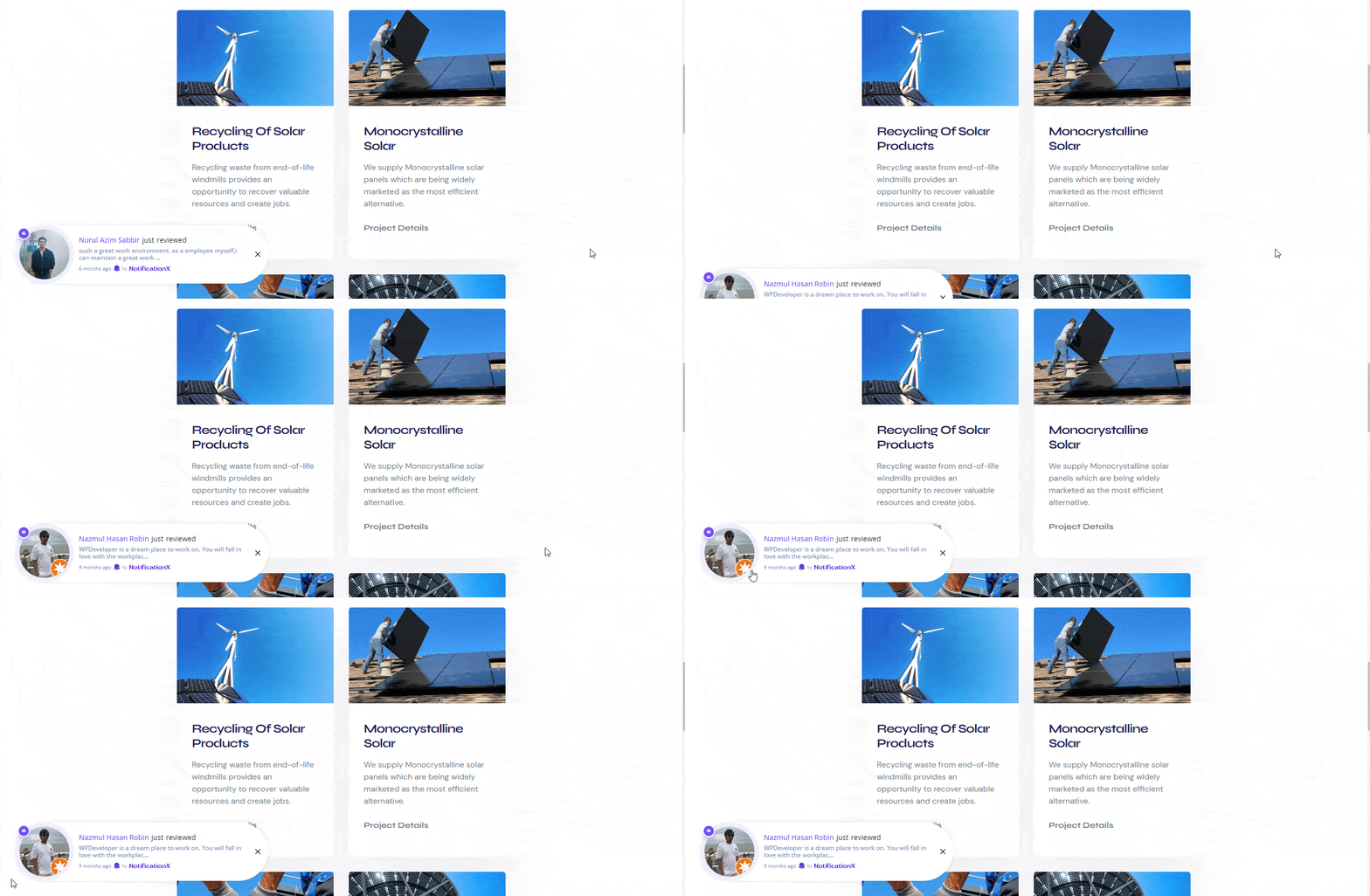
85% of consumers think reviews older than 3 months are not relevant. Continuously collect fresh testimonials and rotate displayed content. Here, NotificationX can be a driving factor. Once the review alert on your website is set, it will continuously show on the website whenever someone drops a new review.
4. Poor Mobile Optimization
With 79% of consumers influenced by user-generated content on mobile devices, failing to optimize social proof for mobile alienates the majority of potential customers. To minimize that risk, you can use plugins like NotificationX. Its Growth Alert is properly responsive, which will automatically adjust the review system for any device.
5. Generic, Non-Specific Testimonials
Testimonials without specific details, measurable results, or context lack credibility. Use detailed case studies with quantifiable outcomes instead of vague praise.
Scarcity Marketing Mistakes
Scarcity is not always about giving FOMO and converting customers, but also to implement in the right way. Here are some of the scarcity marketing mistakes that marketers should avoid.
1. Fake Scarcity Tactics
Using countdown timers that reset on page refresh or claiming false stock limitations destroys brand credibility permanently. Modern consumers check page code and verify claims.
2. Overusing Urgency
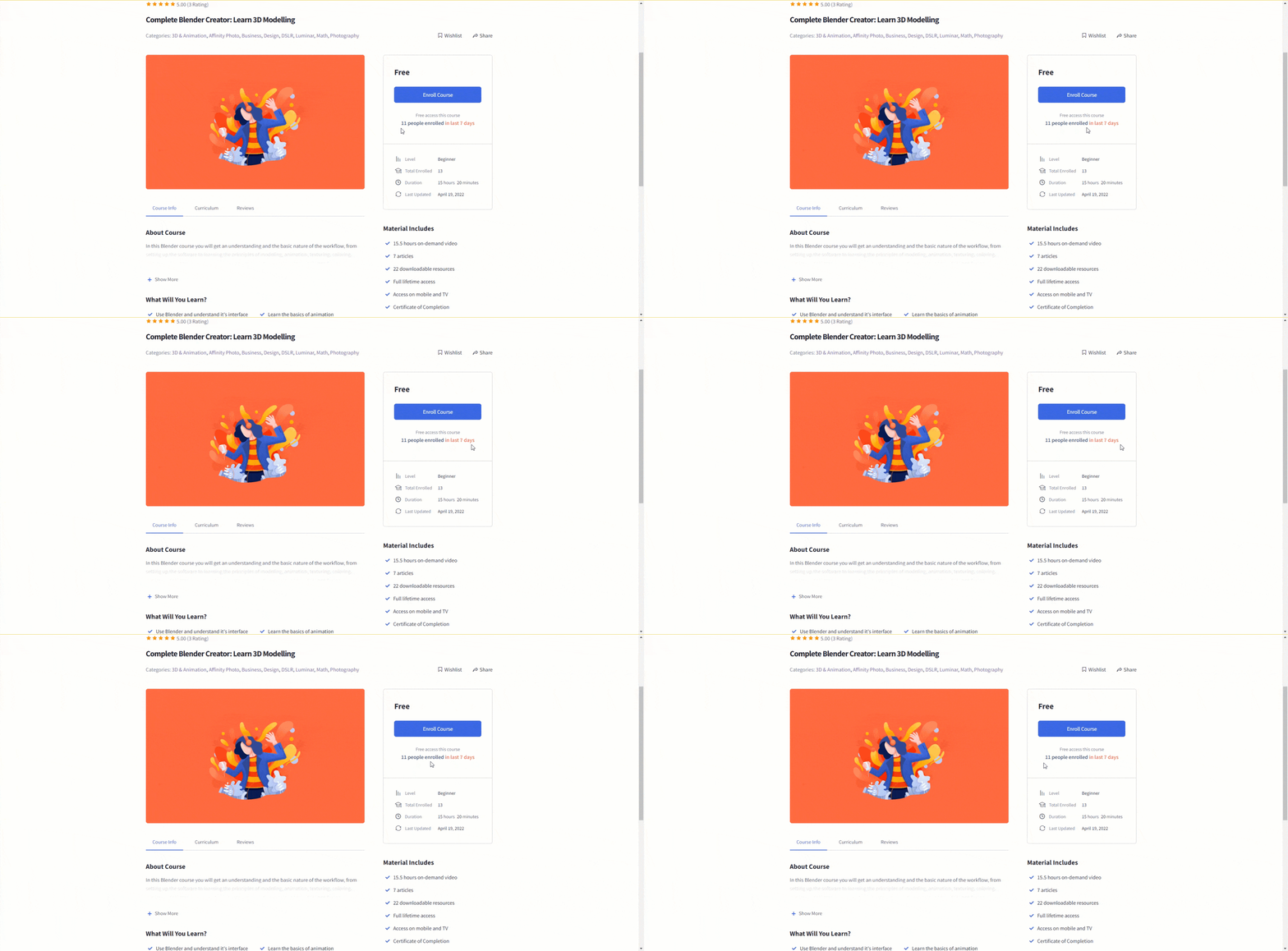
Constant scarcity messaging creates “scarcity fatigue.” When everything is always “Limited Time Only,” nothing is special. Reserve scarcity for genuine opportunities. In NotificationX, you can set the limit and content for the urgency so that it does not feel overwhelming to the website visitors.
3. Mismatching Scarcity Type to Product
Using supply-based scarcity for utilitarian products or demand-based scarcity for luxury items reduces effectiveness. Match scarcity type to product category based on research.
4. Vague Scarcity Claims
“Low stock” is less effective than “Only 3 left in your size.” Specific numbers trigger competition instinct and genuine urgency.
5. Inconsistent Implementation
Creating urgency but then extending deadlines or replenishing “sold out” items immediately teaches customers to ignore future scarcity claims.
Common FAQ on Social Proof And Scarcity Marketing
Can I use social proof and scarcity together, or do they conflict?
They work powerfully together when strategically integrated. Use social proof to build foundational trust and credibility, then layer scarcity to create urgency for action. For example, display customer reviews and ratings (social proof) alongside “Only 2 left at this price” notifications (scarcity). Research shows this combined approach often exceeds the effectiveness of either tactic alone, particularly for e-commerce conversions.
How long does it take to see results from social proof strategies?
Initial results appear once you reach 5+ reviews (the threshold for the 270% purchase likelihood increase), typically within 2-4 weeks of active review collection. However, social proof compounds over time—consistent implementation delivers 62% revenue increases per customer as your review library grows to 50-100+ testimonials.
Is scarcity marketing ethical, or is it manipulation?
Scarcity marketing is ethical when it reflects genuine constraints—real inventory limitations, authentic time-bound offers, or actual supply restrictions. It becomes manipulation when you fake scarcity through reset timers, false stock claims, or artificial limitations. The 2026 standard requires “deterministic scarcity”—if you claim 50 items exist, your database must show exactly 50 items.
Which psychological trigger works better for luxury products?
For luxury and hedonic products, supply-based scarcity (limited editions, exclusive releases) and time-based scarcity show the most substantial effects, as they enhance perceived exclusivity and status. This is particularly effective in highly visible environments. However, social proof remains important for luxury brands—video testimonials and high-profile client endorsements build the necessary trust foundation.
What’s the optimal number of social proof elements to display on a page?
Research indicates 3-5 testimonials on homepage sections strike the optimal balance between credibility and cognitive load. However, maintain a comprehensive library of 100+ testimonials accessible through dedicated pages, as this volume correlates with 37% higher conversions. The key is curating visible social proof for maximum relevance while making the complete collection easily accessible.
How do I measure which tactic is working better for my business?
Implement A/B testing with clear control groups:
- For Social Proof: Measure conversion rate changes before/after adding reviews, track correlation between review volume and sales and monitor time-to-purchase reduction
- For Scarcity: Test with/without scarcity elements, measure cart abandonment rate changes, track average time from first visit to purchase
- Key Metrics: Conversion rate, average order value, cart abandonment rate, time-to-purchase, customer lifetime value
Most businesses see social proof deliver sustainable 10-37% lifts over time, while scarcity creates 98% spikes during campaigns.
My business is brand new with no reviews yet. Should I focus on scarcity instead?
New businesses should prioritize social proof collection immediately while using scarcity selectively. Start with:
- Implement automated review request systems after purchase
- Offer early adopter incentives for detailed feedback
- Collect video testimonials from beta users
- Use limited-time launch pricing (authentic time scarcity) during the review-building phase
- Display real-time activity notifications once you have initial sales
The data shows scarcity effects are actually more pronounced for less-familiar brands, but you still need foundational trust. Use both, but invest heavily in building your social proof library for long-term success.
What’s the biggest mistake companies make when implementing these strategies?
The most damaging mistake is inauthenticity, fake reviews (95% detection rate), or false scarcity (instantly destroys trust). The second biggest mistake is choosing tactics based on trends rather than data. Use demand-based scarcity for utilitarian products, supply-based for luxury items, and always prioritize authentic social proof across all categories. Match your strategy to your specific product type, audience, and customer journey stage rather than copying competitors blindly.
Final Verdict: Implement the Right Strategy for Your Business
The most successful marketers in 2026 understand that social proof builds the foundation of trust, while scarcity creates the urgency to act now. Used authentically and strategically, these psychological principles transform browsers into buyers and skeptics into loyal customers. The key is matching your strategy to your product type, implementation authenticity, and customer journey stage, then measuring ruthlessly and optimizing continuously. Was this blog helpful?
Do not forget to subscribe to our blog for more informational and marketing content. Join our Facebook Community to discuss the latest marketing trends and discussions.




 English
  Arabic
  Indonesian
  Spanish
  Bengali
  Portuguese
  German
  Dutch
Dutch  Russian
  Hindi
Hindi  French
  Japanese
  Chinese
  Vietnamese
  Malay
Malay