
Most marketing problems are not strategy problems. They are visibility problems.
You have campaigns running, content publishing and a website converting at some percentage. But somewhere in that system, there are leaks: points where attention is lost, trust is not earned, or momentum quietly drains away. The hard part is that these leaks are rarely obvious. They do not announce themselves. They just quietly cost you sales, subscribers and growth every single day.
That is what a marketing audit checklist is designed to expose. Not the dramatic failures, but the invisible underperformances that compound over time into meaningful revenue gaps.
This marketing cheat sheet gives you a 16-point digital marketing audit covering every major layer of your marketing system, from traffic and trust to content, conversion and customer retention. Work through it honestly and you will walk away knowing exactly where your biggest opportunities are.
Why Every Marketer Needs a Marketing Cheat Sheet
The phrase ‘cheat sheet’ might sound casual, but the concept is more important than it sounds. A marketing cheat sheet is a structured diagnostic framework: a systematic, point-by-point review of every element that determines whether your marketing is working as hard as it should be.
Without one, marketing teams tend to focus on what is most visible: the channel generating the most traffic, the campaign with the most recent results, the metric in the dashboard that looks most impressive.
But visibility is not the same as performance. A marketing funnel audit forces you to look at the whole system, not just the parts that feel comfortable.
A well-executed digital marketing audit typically reveals three types of issues:
- Quick wins: Small adjustments with immediate impact, like fixing a broken CTA, updating outdated social proof, or improving a subject line.
- Strategic gaps: Structural problems that require planned work, like a missing email nurture sequence or an underoptimized landing page.
- Systemic blind spots: Areas that have been consistently overlooked, like the absence of any FOMO or social proof mechanism on key product pages.
The 16-point framework below addresses all three. Let us begin.
The 16-Point Marketing Audit: Your Complete Marketing Cheat Sheet
Think of this as your marketing system’s health check. Each of the 16 points below targets a specific layer of your marketing, from the traffic coming in to the trust signals keeping visitors on the page to the emails bringing customers back. Some will be in great shape. Others will reveal gaps you did not know existed. Both outcomes are valuable.
Traffic And Visibility
Getting traffic is easy. Getting the right traffic that converts is where the real challenge lies. This section focuses on auditing your visibility channels to ensure your efforts are driving impact, not just numbers.
1. Audit Your Traffic Sources 🔍
Open Google Analytics or your analytics platform of choice and look at where your traffic is actually coming from. Most sites rely far too heavily on a single source, usually organic search or direct traffic, leaving themselves dangerously exposed to algorithm changes and platform policy shifts.
As part of your website traffic audit, ask yourself: if your top traffic source disappeared tomorrow, would your business survive? A healthy traffic mix typically includes organic search, referral, social, email and paid. If more than 60% of your traffic comes from one source, diversification is not optional; it is urgent.
- Check: Top 5 traffic sources by sessions.
- Check: Conversion rate by channel (not just traffic volume).
- Check: Month-over-month trend for each source.
✅ Traffic volume is vanity. Traffic that converts is what matters. Always analyze channel performance by revenue and conversion rate, not just visits.
2. Audit Your SEO Foundation 🔑
SEO audit for marketers does not need to be a deep technical exercise to be valuable. At the marketing level, you are checking whether the right pages rank for the right terms, whether your content is being indexed and whether your on-page optimization reflects your current keyword strategy.
- Check: Are your highest-value pages ranking on page 1 for target keywords?
- Check: Are there cannibalization issues where multiple pages compete for the same term?
- Check: Do your title tags and meta descriptions reflect current search intent?
- Check: Is your core content marked up with relevant schema?
A focused SEO audit for marketers once per quarter catches ranking decay before it becomes a traffic problem. Pages that ranked well 6 months ago can slide silently without a regular check.
3. Audit Your Paid Ads Performance 💰
Paid ads audit is where marketing budgets most visibly either work or waste. The most common issue is not that campaigns are performing badly; it is that they are performing well enough that no one questions them. ‘Good enough’ in paid advertising often means significantly below potential.
- Check: Cost per acquisition (CPA) vs. customer lifetime value (CLTV).
- Check: Quality score and relevance score by campaign and ad group.
- Check: Are you sending paid traffic to optimized landing pages, or to generic product/homepage URLs?
- Check: Frequency caps on retargeting campaigns — ad fatigue is a silent budget drain.
The single highest-impact finding in most paid ads audit exercises is that paid traffic is being sent to unoptimized landing pages. Traffic quality is not the problem, destination quality is.
Website And Conversion
Your website is where all your marketing efforts come together and where conversions either happen or get lost. This section focuses on auditing the key elements that directly impact performance, from speed and user experience to landing pages, funnels and trust signals.
4. Audit Your Site Speed and Mobile Experience ⚡
Website conversion optimization starts before a visitor reads a single word. Site speed and mobile experience are the gatekeepers of every other optimization you make. If the page is slow or broken on mobile, nothing else matters.
Fact:📊 The conversion rate is 3x higher for eCommerce websites that load in 1 second compared to those that take 5 seconds. (Convertcart, 2026)
- Check: Google PageSpeed Insights score for your top 10 traffic pages.
- Check: Core Web Vitals (LCP, FID, CLS) in Google Search Console.
- Check: Does your mobile experience convert at a comparable rate to desktop?
- Check: Are third-party scripts (analytics, chat widgets, marketing tools) slowing your pages?
5. Audit Your Landing Pages 🎯
Landing page optimization is consistently one of the highest-ROI activities in any digital marketing audit. A landing page is a controlled environment designed to do one job: convert. If it is doing anything other than moving visitors toward that single goal, it is underperforming by design.
- Check: Does every landing page have a single, clear call to action?
- Check: Does the page headline match the ad or link that sent the visitor there?
- Check: Is there social proof visible above the fold?
- Check: Is the value proposition stated in the first 5 seconds of the user experience?
- Check: Are you A/B testing any element of your highest-traffic landing pages?
If your landing page optimization checklist has not been reviewed in the last 90 days, it is almost certainly overdue. The average landing page conversion rate across industries is 2.35% (the top 25% convert at 5.31% or above). The difference is almost always optimization, not traffic quality.
6. Audit Your Conversion Funnel 🛒
Marketing funnel audit maps where visitors enter your site, where they drop off and where they convert. Most businesses know their headline conversion rate. Very few know where in the funnel the losses are happening.
A focused conversion rate optimization checklist review of your funnel should identify the single step with the highest abandonment rate. That step is your biggest conversion opportunity, and fixing it is more valuable than optimizing everything else combined.
- Check: funnel visualization in Google Analytics for your primary conversion path
- Check: cart abandonment rate for eCommerce (industry average is 70-75%)
- Check: form abandonment rate if lead generation is a primary goal
- Check: are there friction points in checkout — unnecessary form fields, lack of payment options, no trust signals at the point of payment?
7. Audit Your Social Proof And Trust Signals 🔔
This is the audit point most marketing cheat sheet resources skip entirely and it is one of the most impactful. Trust is not a soft, qualitative metric. It is a direct conversion driver that affects every page, every campaign, and every channel you operate.
📊 97% of visitors hesitate to buy because of a lack of credibility. Businesses that display strong social proof signals see conversion lifts of 10-15% on average. (PemberitahuanX)
Social proof marketing works because of a well-documented psychological principle: people look to the behavior of others to determine the correct action in uncertain situations. When a visitor sees that 500 people bought a product in the last 7 days, that information reduces uncertainty and accelerates the purchase decision.
- Check: Are customer reviews visible on product and landing pages?
- Check: Are recent purchase or signup notifications displayed to new visitors?
- Check: Is there a star rating or testimonial visible above the fold on your highest-traffic pages?
- Check: Are trust badges (security seals, payment logos, guarantees) present at checkout?
- Check: Does your site show real-time activity that signals a live, active buying community?
🔔 This is exactly what NotificationX was built for. It displays real-time bukti sosial notifications (recent purchases, sign-ups, reviews, download counts, low-stock alerts and more) as unobtrusive popup notifications on your WordPress site.
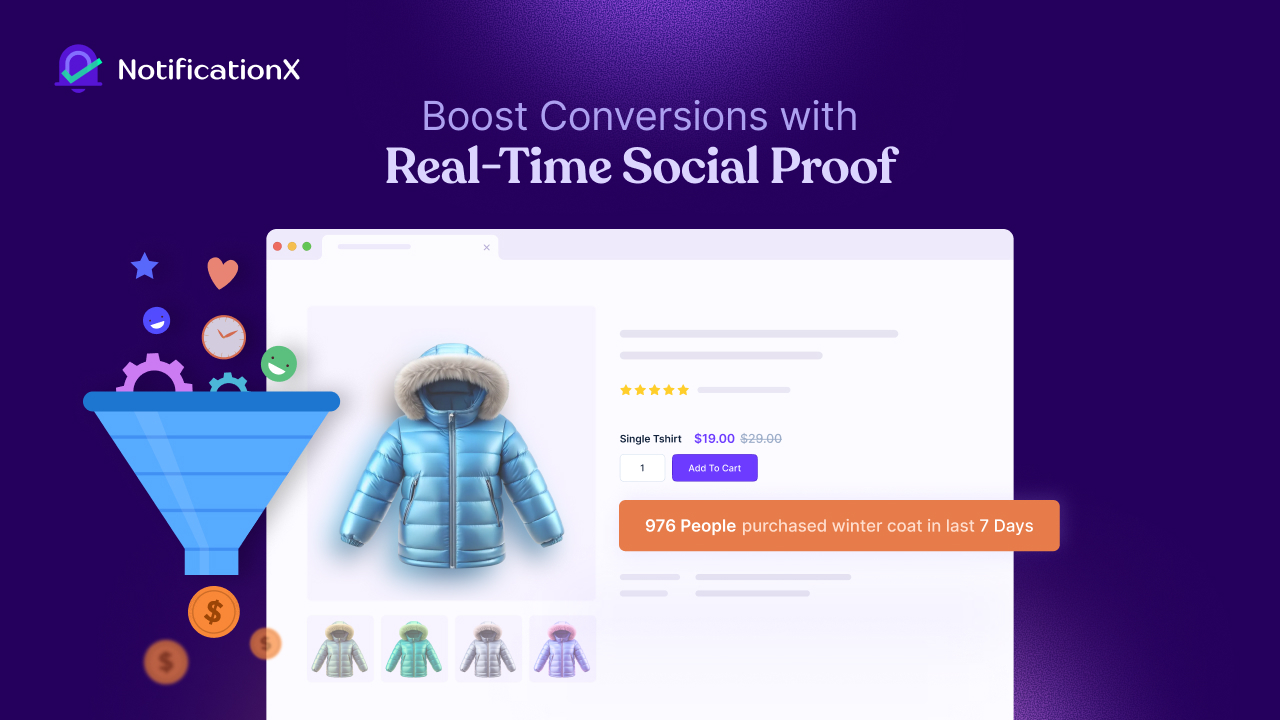
When a visitor sees ’14 people bought this in the last 24 hours,’ that single signal can be the difference between a bounce and a conversion. NotificationX is free to install and typically shows measurable impact within 7 to 14 days of activation.
8. Audit Your FOMO And Urgency Elements ⏳
FOMO marketing strategy is one of the most psychologically potent tools in a marketer’s arsenal and one of the most frequently underused. FOMO (Fear of Missing Out) drives action by making inaction feel costly. When people believe an opportunity is limited or temporary, they are significantly more likely to act immediately rather than defer.
📊 60% of millennial consumers make reactive purchases within 24 hours after experiencing FOMO.
- Check: Do your highest-value pages use any form of urgency or scarcity?
- Check: Are countdown timers used on promotional or time-limited offers?
- Check: Is low-stock messaging displayed on product pages when relevant?
- Check: Are announcement bars or notification banners used for active promotions?
Critically, the strategi pemasaran FOMO must be honest. Manufactured scarcity that visitors can see through destroys trust faster than it creates urgency. Only use real deadlines, real stock limits, and real activity data. When FOMO is genuine, it accelerates decisions. When it is fake, it triggers skepticism.
🔔 NotificationX powers genuine FOMO by pulling real data from your WooCommerce store, Easy Digital Downloads, or other integrations showing actual sales counts, real signup activity, live download stats and authentic low-stock alerts. No fake numbers, no manufactured urgency. The data is real, which makes the social proof trustworthy and the FOMO effective.
Content And Messaging
Strong content and clear messaging can turn casual visitors into loyal customers. But without regular evaluation, even consistent efforts can fall flat. This section focuses on refining your content strategy, sharpening your value proposition and leveraging testing to improve performance.

9. Audit Your Content Marketing Strategy 📝
Content marketing audit is the process of evaluating whether your content is actually doing a job in your marketing system, or just accumulating on your blog without meaningful impact. Most websites have a content problem that looks like a traffic problem: they are publishing regularly, but the content is not attracting the right audience, converting readers into leads, or building topical authority.
- Check: Which 20% of your content is generating 80% of your traffic and leads?
- Check: Is each piece of content mapped to a stage of the buyer journey?
- Check: Does every blog post or content piece have a clear next action for the reader?
- Check: When did you last update your highest-traffic content with fresh data and examples?
A content marketing audit should result in three lists: content to keep and optimize, content to update and content to consolidate or remove. Most sites would benefit from doing less content but doing it more deliberately.
10. Audit Your Value Proposition Clarity 💡
Your value proposition is the single most important sentence on your website. It answers the question every visitor arrives with: why should I buy from you rather than anyone else? If your value proposition is not immediately clear, compelling and differentiated, every other marketing optimization you make will underperform.
- Check: Can a first-time visitor understand exactly what you offer within 5 seconds?
- Check: Does your headline address a specific pain point or desired outcome?
- Check: Is your value proposition consistent across your homepage, ads, and email?
- Check: Does it communicate a specific benefit rather than a generic claim?
✅ Test your value proposition by showing your homepage to someone unfamiliar with your brand for 5 seconds, then asking them to explain what you do and who it is for. If they cannot answer accurately, your value proposition needs work.
11. Audit Your A/B Testing Activity 🧪
A/B testing marketing is the only reliable way to know what actually works for your specific audience on your specific site. Every other optimization is an educated guess. A/B testing converts guesses into decisions backed by data.
Most marketing teams run far fewer tests than they should. The main barriers are perceived complexity and uncertainty about what to test. The reality is that A/B testing marketing can be as simple as testing two subject lines in an email campaign or two headline variants on a landing page.
- Check: Are you actively running any A/B tests right now?
- Check: Do you have a documented testing backlog?
- Check: Are test results archived so the team can learn from historical data?
- Check: Are you testing one variable at a time?
Email And Retention
If acquisition is the engine of your store, email and retention are the fuel that keeps it running. From welcome sequences to post-purchase experiences, optimizing this stage is key to turning one-time buyers into loyal customers.
12. Audit Your Email Marketing Performance 📧
Email marketing optimization is consistently the highest-ROI channel in eCommerce marketing strategy. The average return on email marketing investment is $36 for every $1 spent, higher than any other digital marketing channel. Yet most email programs are dramatically underoptimized.
📊 Email marketing delivers an average ROI of $36 for every $1 spent — the highest of any digital marketing channel. (Litmus, 2026)
- Check: Are your welcome sequence open rates above 40% (industry benchmark)?
- Check: Are abandoned cart emails set up and generating recoveries?
- Check: Is your list segmented by purchase history, behavior, or interest?
- Check: When did you last clean your list to remove inactive subscribers?
- Check: Are you personalizing beyond first name insertion?
The most impactful email marketing optimization is usually the welcome sequence. It is the highest-engagement moment in a subscriber’s relationship with your brand and most welcome sequences end after one or two generic emails. A properly built 5 to 7 email welcome sequence can increase lifetime value by 30% or more.
13. Audit Your Customer Retention Strategy 🔁
Customer retention marketing is the most underinvested area in most eCommerce marketing strategy plans. Brands obsess over acquisition while the customers they have already won quietly drift away.
- Check: What is your repeat purchase rate over the last 12 months?
- Check: Do you have a post-purchase nurture sequence that extends beyond order confirmation?
- Check: Is there a loyalty or rewards program in place?
- Check: Are you running win-back campaigns for customers who have not purchased in 90 or 180 days?
Retention is not just a financial metric. It is a trust metric. Customers who come back are customers who trust you enough to spend again. Customer retention marketing is, therefore, directly connected to every trust-building element in your marketing cheat sheet.
14. Audit Your Post-Purchase Experience 🤝
The moment after a customer buys is one of the most psychologically powerful moments in the entire customer relationship. It is when trust is highest and the brand impression is most malleable. Most brands waste it with a generic order confirmation and nothing more.
- Check: Does your order confirmation email do more than confirm the order?
- Check: Are customers invited to review their purchase at the optimal moment (post-delivery, not post-purchase)?
- Check: Is there any educational content, usage guide, or value-add content in the post-purchase sequence?
- Check: Is there a referral or affiliate invitation in the post-purchase flow?
✅ The post-purchase period is the optimal moment to ask for a review. A customer who has just received their order and is satisfied is at the peak of their positive brand sentiment. Automating a review request 5 to 7 days post-delivery captures that moment consistently.
Brand And Trust
Trust is not built overnight; it is earned through consistent actions, meaningful experiences and authentic communication. Your brand is the sum of those moments. In this section, we take a closer look at how well your brand tells its story, delivers on its promises, and earns lasting trust.

15. Audit Your Brand Trust and Reputation 🏆
Brand trust strategy is the connective tissue between every other point in this marketing audit checklist. It determines whether your traffic converts, whether your email subscribers buy, whether your social proof is believed and whether your FOMO creates genuine urgency or cynical eye-rolls.
Trust is built across time and touchpoints. It is the aggregate of every review, every customer service interaction, every product delivery and every piece of content you publish. But it can also be communicated in real time through the signals you display at key decision-making moments.
- Check: What is your average star rating on Google, Trustpilot and relevant review platforms?
- Check: Are you responding to reviews — positive and negative?
- Check: Is your brand story and founding narrative present and compelling on your About page?
- Check: Are press mentions, awards, or third-party validations displayed prominently?
- Check: Does your brand voice feel consistent across websites, email, and social?
A brand trust strategy that earns and displays genuine social proof across multiple platforms is not just a reputation exercise; it is a conversion optimization strategy with documented ROI at every stage of the funnel.
16. Audit Your Marketing Analytics Setup 📊
The final point in this marketing cheat sheet is arguably the most foundational: if your analytics are not set up correctly, every other audit finding is based on unreliable data. You cannot optimize what you cannot measure accurately.
- Check: Is Google Analytics 4 (GA4) properly configured with the correct tracking code on all pages?
- Check: Are conversion events (purchases, form completions, email sign-ups) tracked as goals?
- Check: Is UTM tagging applied consistently to all campaign URLs?
- Check: Are you tracking marketing metrics beyond surface level — attribution model, LTV, and channel-specific CAC?
- Check: Do you have a regular reporting cadence that ties marketing activity to revenue?
Without reliable data, website conversion optimization is guesswork. With it, every experiment has a clear hypothesis, every optimization has a measurable outcome, and every budget decision is grounded in evidence rather than intuition.
How NotificationX Addresses Multiple Points on This Marketing Cheat Sheet
Several of the 16 audit points above share a common solution: the ability to display real-time, authentic behavioral signals that build trust, create urgency and accelerate purchase decisions at exactly the right moment.
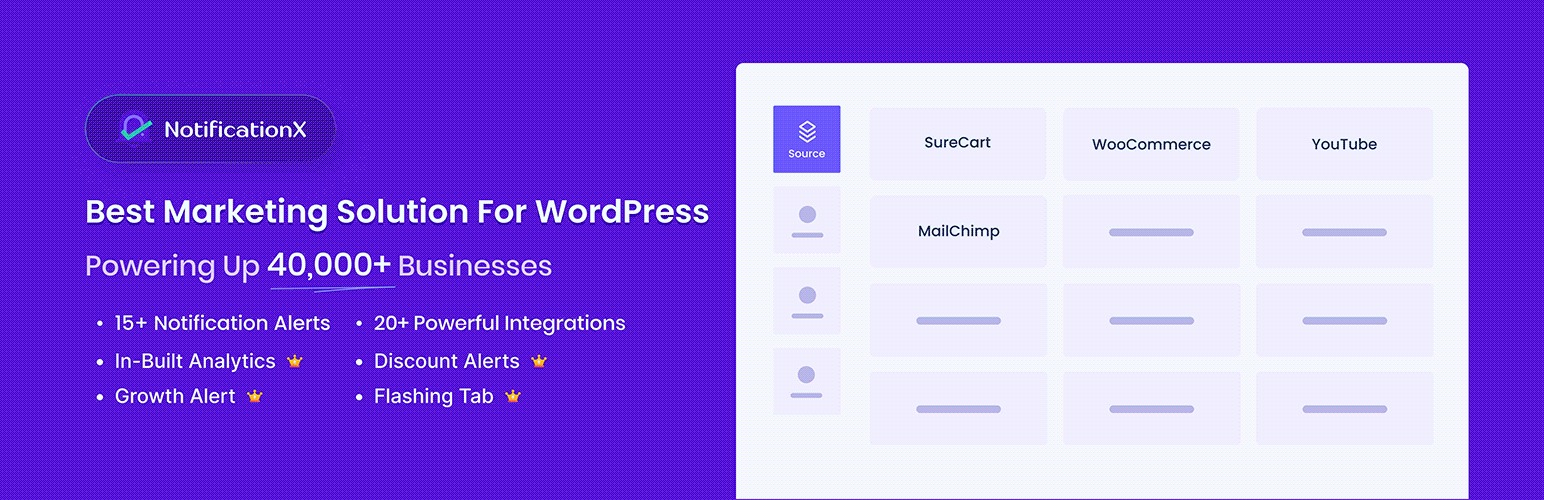
PemberitahuanX is a WordPress plugin trusted by 40,000+ businesses that addresses Points 7 (Social Proof), 8 (FOMO) and indirectly supports Points 4, 5, 6, 13, and 15 by improving on-site trust signals that lift conversion rates across the board.
What NotificationX Does
- Real-time sales notifications: show visitors that others are actively buying from your store, right now
- Recent signup alerts: display email subscriptions and registrations to signal an active, growing community
- Review and rating showcases: surface your best customer feedback at key decision points in the user journey
- Download and enrollment counts: for digital products, courses, or resources, show momentum that builds confidence
- Low stock notifications: create genuine urgency for products with limited availability
- Announcement bars: promote active campaigns, discounts and limited-time offers with floating notification banners
- Analytics dashboard: track clicks, views, and click-through rates on every notification to optimize performance over time
The most important thing about NotificationX is that it uses real data from your WooCommerce store, Easy Digital Downloads, LearnDash, Envato and 19+ other integrations. This is not manufactured urgency or fake social proof. It is your actual activity, displayed at the moments when it is most likely to influence a purchase decision.
If your marketing audit checklist reveals gaps in social proof or strategi pemasaran FOMO, NotificationX is one of the fastest implementations available. It installs in minutes, requires no coding, and typically shows measurable impact within the first two weeks.
🔔 NotificationX has a free version available on WordPress.org that includes core social proof and FOMO notification types with no impression limits. Paid plans start from $39/year for extended integrations, advanced analytics, and cross-domain notification display.
How to Prioritize: Where to Start With Your Marketing Audit
Sixteen points is a comprehensive marketing cheat sheet. Not every business will have gaps in all 16 areas and not every gap is equally urgent. Here is a simple prioritization framework:
- Start with the highest-traffic, lowest-converting pages. These are your biggest revenue opportunities. Points 4, 5, 6, 7 and 8 (speed, landing pages, funnel, social proof, FOMO) are the most directly tied to conversion rate improvement.
- Then address your traffic and visibility foundation. Points 1, 2, and 3 (traffic sources, SEO, paid ads) determine the volume of opportunity you have to convert. Leaky traffic acquisition compounds every other problem.
- Then build your retention and trust infrastructure. Points 12, 13, 14, and 15 (email, retention, post-purchase, brand trust) determine the lifetime value of every customer you acquire through the channels above.
- Finally, close the analytics loop. Point 16 ensures that every improvement you make is measurable and that future optimization cycles are grounded in accurate data.
The Audit Is Not the End, It Is the Beginning
A marketing cheat sheet is only valuable if it leads to action. The 16 points above are a diagnostic, not a deliverable. Work through them, identify your 3 to 5 biggest gaps, and build a 30-day sprint around closing them.
The most impactful digital marketing audit findings are almost never dramatic. They are small, fixable, compounding issues: a landing page with no social proof, an email sequence that ends too early, a checkout flow with too much friction, a website showing no sign of active customer activity.
Fix those things (systematically, measurably, and consistently) and your marketing compounds in your favor. That is what this marketing cheat sheet was built to help you do.
Start your audit today. Run it every quarter. And let the results, not assumptions, guide where you invest your time and budget.
Berlangganan ke blog kami for more actionable tips on marketing to grow your business. Join our Komunitas Facebook to connect with people like you and share your experiences.
FAQs: Marketing Audit Cheat Sheet
What is a marketing audit checklist?
SEBUAH marketing audit checklist is a structured review of all the key components of your marketing system — traffic, conversion, content, email, retention and brand trust — designed to identify gaps, underperforming areas, and quick wins that can be addressed to improve overall marketing effectiveness.
How often should I run a marketing audit?
A full digital marketing audit should be run at a minimum of quarterly. Specific elements, such as paid ads audit dan email marketing optimization, benefit from a monthly review. Site speed and conversion monitoring should be ongoing using analytics dashboards.
What is social proof marketing and why does it matter?
Pemasaran bukti sosial is the practice of displaying the behavior and opinions of other customers, such as reviews, purchase notifications, and subscriber counts, to build trust with new visitors. It matters because 97% of visitors hesitate to buy due to credibility concerns, and visible social proof directly addresses that hesitation at the point of purchase.
What is FOMO marketing?
strategi pemasaran FOMO leverages the psychological principle of Fear of Missing Out to motivate visitors to act now rather than defer. Effective FOMO tactics include displaying real-time purchase activity, showing low-stock alerts, and using countdown timers for genuine limited-time offers. The key distinction is that FOMO must be based on real data to maintain trust.
How does NotificationX help with website conversion optimization?
NotificationX displays real-time social proof and FOMO notifications on WordPress sites, including recent purchases, sign-ups, review showcases, download counts, and low-stock alerts. This directly addresses website conversion optimization by reducing visitor hesitation through visible proof that others are actively buying and engaging. It integrates with WooCommerce and 19+ other platforms, requires no coding, and is free to install.
What is the fastest way to improve my conversion rate?
The fastest wins in conversion rate optimization checklist reviews are typically: adding visible social proof to product and landing pages, improving page load speed, simplifying checkout friction, aligning landing page headlines with the ads that drive traffic to them, and implementing a basic FOMO mechanism on high-intent pages. These changes typically deliver measurable results within 2 to 4 weeks.




 English
  Arabic
  Indonesian
  Spanish
  Bengali
  Portuguese
  German
  Dutch
Dutch  Russian
  Hindi
Hindi  French
  Japanese
  Chinese
  Vietnamese
  Malay
Malay