
What if 80% of your content results were coming from just 20% of your content efforts and you did not even know it?
That is not a hypothetical scenario. It is the reality for most content marketers, bloggers, and SEO professionals. Some posts drive the bulk of your traffic. A handful of keywords bring in the most leads. A small percentage of your content ideas generate the most shares, backlinks, and conversions.
This pattern has a name: the Pareto Principle, commonly known as the 80/20 rule.
Understanding and applying the Pareto Principle to your content strategy is one of the smartest moves you can make as a marketer. Instead of working harder, you start working smarter by focusing your time, budget, and creative energy on the 20% of actions that deliver 80% of the results.

In this guide, we will walk you through everything you need to know: what the Pareto Principle is, where it comes from, how it applies specifically to content marketing and SEO, and the exact steps you can take to implement it right now.
What Is the Pareto Principle? (The 80/20 Rule Explained)
los Pareto Principle states that roughly 80% of outcomes come from 20% of causes. In other words, a small fraction of your inputs is responsible for the vast majority of your results.
The principle is named after Vilfredo Pareto (1848–1923), an Italian economist and sociologist. In 1896, Pareto first observed this imbalanced distribution while studying wealth in Italy. He found that approximately 80% of the land was owned by just 20% of the population. Remarkably, when he investigated other countries, he found the same disproportionate pattern everywhere.
The insight struck him in his own garden, too: 20% of his pea pods were producing 80% of the peas. Nature itself was obeying the same rule.
Pareto’s observation lay dormant as a broader principle until 1941, when American quality management consultant Joseph M. Juran formalized it. Juran applied Pareto’s distribution to quality control, coining the famous phrase “the vital few and the useful many.” It is the phrase that captures the essence of what makes the 80/20 rule so practical. In simple terms:
A small number of inputs produce a disproportionately large share of outputs. Not everything you do has an equal impact. A few things matter a lot. Most things matter less.
It is important to note that 80/20 is a rule of thumb, not a fixed law. The actual split in your business might be 70/30 or 90/10. The exact numbers are less important than the underlying insight: results are not evenly distributed.
The 80/20 Rule in Business and Marketing: Real-World Examples
The Pareto Principle has proven remarkably consistent across industries and disciplines. Before diving into content strategy, it helps to see how broadly this principle applies:
- 80% of your sales come from 20% of your customers
- 80% of your revenue comes from 20% of your products
- 80% of your complaints come from 20% of your customers
- 80% of your website traffic comes from 20% of your pages
- 80% of your social media engagement comes from 20% of your posts
- 80% of your organic leads come from 20% of your keywords
- 80% of your backlinks point to 20% of your pages
Each of these is a direct application of the same fundamental observation. Once you start looking for it, you will find the 80/20 pattern everywhere in your marketing data.
Why the Pareto Principle Matters for Content Strategy
Content marketing is resource-intensive. Writing a high-quality blog post takes hours. Producing a video, podcast episode, or lead magnet takes even longer. Social media management, email newsletters, and content distribution, the workload compounds fast.
Most content marketers respond to this pressure by producing more content. More blog posts. More social updates. More videos. More everything.
But here is the uncomfortable truth: most of that content is underperforming. A small percentage of your published content is driving the vast majority of your organic traffic, leads, and conversions. The rest barely moves the needle.
The 80/20 content strategy shifts the question from “how do we create more?” para “how do we create better and double down on what already works?”
This reframe is powerful for three reasons:
- It aligns effort with impact. You stop spending equal time on all content and start investing disproportionately in the content that delivers disproportionate results.
- It reduces wasted output. Rather than publishing 20 mediocre posts, you publish 5 exceptional ones and optimize the top performers you already have.
- It creates compounding returns. When you identify your 20% of highest-performing content and actively improve, update, and promote it, you compound the results it generates over time.
How to Apply the Pareto Principle to Your Content Strategy (Step-by-Step)
Most content teams publish consistently, experiment with formats, and chase every new trend. Yet a small fraction of that content drives the vast majority of results.
That is the Pareto Principle at work. The 80/20 rule suggests that 80% of outcomes come from just 20% of inputs. In content strategy, a handful of posts, pages, or videos are likely responsible for most of your traffic, leads, and conversions.
The question is: are you using that pattern to your advantage? Here is how.
Step 1: Conduct a Content Audit to Find Your Top 20%
Before you can apply the 80/20 rule, you need to know which 20% of your content is driving 80% of your results. This starts with a content audit.
Open Google analitico y Google Search Console and look for:
- Which pages receive the most organic traffic
- Which pages generate the most conversions or leads
- Which posts attract the most backlinks
- Which URLs have the highest average time on page and the lowest bounce rate
- Which pieces of content get the most social shares
Sort your content by each of these metrics and identify the clear top performers (typically 10–20%) of your total content library. These are your vital few: the posts that are actively growing your business.
Once identified, these pages become your priority assets. They deserve more attention, more promotion, more internal links, and regular updates to keep them performing.
Consejo: Use tools like Ahrefs, SEMrush, o Screaming Frog to pull a full content inventory and overlay organic traffic and backlink data. This gives you a complete picture of your content performance in one view.
Step 2: Apply the 80/20 Rule to Keyword Research
Keyword research is one of the most time-consuming activities in content marketing and one of the areas most prone to wasted effort. Teams spend weeks researching thousands of keywords, many of which deliver little to no traffic or conversions.

The Pareto approach to keyword strategy is to identify the small cluster of high-intent, high-value keywords that drive most of your organic results and focus your efforts there.
Here is how to do it:
Find your 20% of high-performing keywords:
- In Google Search Console, go to the Performance report and sort keywords by clicks, impressions, and click-through rate
- Identify which keywords are driving the bulk of your organic traffic
- Note which keywords also appear to drive conversions (use GA4 to connect traffic to goal completions)
Target high-intent keywords over high-volume keywords: High search volume does not equal high impact. A keyword like “best email marketing tool for eCommerce” has far lower volume than “email marketing” but users searching it are much closer to making a decision. These high-intent, long-tail keywords represent your highest-value 20%.
Prioritize keywords where you rank on page 2: Pages ranking in positions 11–20 sit just outside the traffic sweet spot. A focused optimization push on these pages, improving content depth, adding internal links, refreshing metadata can push them into the top 10 and dramatically increase clicks with minimal effort.
Keyword Clusters to Prioritize:
- Informational 20%: “What is [X]”, “How does [X] work” (great for top-of-funnel awareness and featured snippets)
- Comparison 20%: “[X] vs [Y]”, “best [X] for [use case]” (high intent, conversion-friendly)
- Tutorial 20%: “How to [achieve outcome]” (drives high engagement and backlinks)
- Long-tail commercial 20%: “buy [X] online”, “[X] for [specific audience]” (strong conversion signals)
Step 3: Create Less Content, But Make It Exceptional
The 80/20 principle does not mean publishing only 20% as much content. It means allocating 80% of your content creation budget to the formats, topics, and channels that deliver 80% of your results.
This leads to a very specific content creation philosophy:
Identify your highest-performing content formats: Look at your top-performing content and ask: What do they have in common? Are they long-form guides? How-to tutorials? Case studies? Comparison posts? Data-driven research? Whatever format consistently performs best for your audience, that is your 20%.
Go deep rather than wide: Instead of publishing a surface-level post on 10 different subtopics, publish one comprehensive, deeply researched pillar post on your highest-value topic. A single 3,000-word cornerstone article that answers a question thoroughly will outperform ten 300-word posts scattered across the same topic.
Content types that consistently represent the high-performing 20%:
- Ultimate guides and comprehensive tutorials: attract backlinks naturally and rank for multiple related keywords
- Original research and data studies: earn citations, press coverage, and high-authority backlinks
- Comparison and “best of” posts: capture high-intent buyers at the decision stage
- Case studies: build trust and convert browsers into buyers
- Answer-focused FAQ content: optimized for featured snippets and AI Overviews (AEO)
Step 4: Update And Optimize Your Top 20% Before Creating New Content
One of the highest-ROI activities in content marketing and one that most teams neglect is refreshing and optimizing existing high-performing content.
If a post is already driving traffic and ranking, it has demonstrated its value. The content is indexed, trusted, and has earned backlinks. A focused update can significantly improve its performance without starting from scratch.

How to optimize your top-performing 20%:
- Refresh outdated statistics and examples: search engines reward freshness
- Expand thin sections: add more depth to sections that are underdeveloped compared to top-ranking competitors
- Improve on-page SEO: review title tags, meta descriptions, H2 structure, and keyword placement
- Add internal links: link to and from this post to strengthen its topical authority
- Optimize for featured snippets: add concise, structured definitions and numbered lists that directly answer search queries
- Improve the introduction: tighten the hook so users stay on the page longer
- Add new media: custom images, infographics, or video embeds to reduce bounce rate
This is the Pareto Principle at its most powerful in content: spending an hour optimizing a post that already ranks can generate more additional traffic than spending 10 hours writing a new post from scratch.
Step 5: Focus Distribution Efforts on Your Top-Performing Channels
Just as 20% of your content drives 80% of your traffic, 20% of your distribution channels are likely delivering 80% of your content’s reach and engagement.
Most content teams spread promotion across every possible channel (email, Twitter/X, LinkedIn, Instagram, Pinterest, Facebook, Reddit, Quora), often with minimal results on most platforms.
The 80/20 approach: identify the two or three channels where your content consistently performs best, and allocate the majority of your promotional effort there.
How to identify your top distribution channels:
- In Google Analytics, check Acquisition → Traffic Acquisition to see which channels send the most engaged visitors (not just the most visitors)
- Review email campaign data: which newsletters or sequences generate the most clicks back to your content?
- Analyze social media analytics: which platforms drive traffic that converts, not just traffic that bounces?
Once you know your highest-performing distribution channels, the 80/20 rule tells you to stop trying to be everywhere and dominate the channels that actually work for your audience.
Step 6: Apply the 80/20 Rule to Your Content Calendar
Most editorial calendars try to produce content consistently across every topic and category. The Pareto approach is different: identify the 20% of content topics and content categories that generate 80% of your business results, and build your calendar around those.
How to restructure your content calendar using 80/20:
- Identify your highest-traffic topic clusters: these are the content categories that your audience consistently engages with and that your site ranks well for
- Reduce or eliminate low-ROI content categories: if you are producing weekly posts on a topic that never drives traffic, leads, or engagement, apply the 80/20 lens and cut or deprioritize it
- Double down on proven topic clusters: create pillar pages, supporting cluster content, and multimedia assets around your top-performing subject areas
- Build topic authority, not just content volume: search engines increasingly reward sites that go deep on specific topics, not sites that publish superficially on many topics
Step 7: Use the 80/20 Rule for Link Building
Backlinks are one of the most important ranking factors in SEO and link building is also one of the most resource-intensive activities in the entire content marketing toolkit.

The 80/20 principle is essential here: most of your backlinks will come from a small number of your pages, and a small number of your outreach efforts will produce the vast majority of your link wins.
Where to focus your 80/20 link-building efforts:
- Your top-performing pillar content — these posts already rank well and attract natural links. Actively promote them to amplify that link acquisition
- Original data and research — these assets are link magnets because other content creators need to cite statistics
- Digital PR and expert quotes — a small number of high-authority placements deliver more SEO value than dozens of low-authority guest posts
- Broken link reclamation — finding and reclaiming unlinked brand mentions or broken links to your content delivers links with minimal effort
- Competitor backlink analysis — find the 20% of link sources sending the most authority to your competitors, and target those same sources for your content
The 80/20 Rule for Content Marketing: Common Mistakes to Avoid
Understanding the Pareto Principle is one thing and applying it without falling into common traps is another. Here are the mistakes most marketers make:
Neglecting the Other 80% Entirely
The 80/20 rule does not mean your other content is worthless. It means your priorities should be clear. Your supporting content still matters because it builds topical authority, captures long-tail traffic, and feeds users into your high-performing content.
Treating the 80/20 Split as Permanent
Your top-performing 20% changes over time. Search trends evolve, competitor content improves, and audience interests shift. Conduct a content audit at least every six months to recalibrate your 20%.
Using the Rule as an Excuse to Stop Creating New Content
The 80/20 rule is not permission to stop publishing. It is a framework for smarter resource allocation. New content seeds your future 20% and without it, your high performers will eventually age out.
Applying 80/20 Only to Content Volume, Not Content Quality
The real power of the principle is in quality, not just quantity. Applying 80% of your research, writing time, and creative effort to your highest-value pieces is what drives exceptional content, not just publishing fewer pieces.
How the Pareto Principle Applies to SEO (Technical and On-Page)
The 80/20 rule extends beyond content creation into the technical and on-page SEO work that supports your content strategy.
Technical SEO: Dozens of technical SEO issues can affect a website at any given time. But the 80/20 rule holds here too: a small number of technical problems cause the majority of ranking issues. The highest-impact technical fixes to prioritize are:
- Site speed and Core Web Vitals: slow pages hurt rankings and user experience
- Mobile responsiveness: with mobile-first indexing, this is non-negotiable
- Crawl errors and broken links: pages that cannot be crawled cannot rank
- Canonical tags and duplicate content: these confuse search engines and dilute ranking signals
- XML sitemaps and robots.txt: ensure all important pages are discoverable
On-Page SEO: Focus 80% of your on-page optimization effort on your top-performing 20% of pages. Improving title tags, meta descriptions, heading structures, internal linking, and schema markup on your highest-traffic pages delivers far more impact than optimizing low-traffic pages.
Applying the Pareto Principle to AEO (Answer Engine Optimization)
As AI-powered search experiences like Google’s AI Overviews, ChatGPT, and Perplexity become more prominent, Answer Engine Optimization (AEO) is becoming an essential complement to traditional SEO.
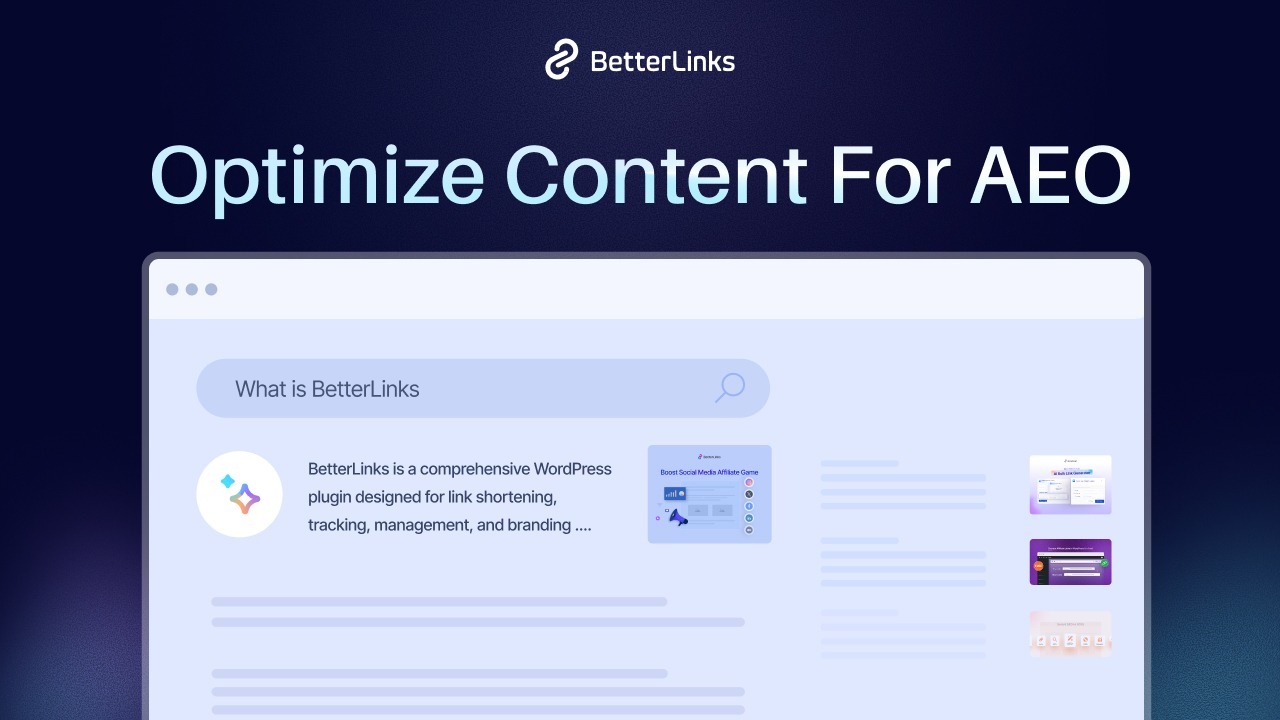
The 80/20 principle applies here, too. A small percentage of your content, specifically, content that is structured to directly answer common questions, will drive the vast majority of your AI citation and featured snippet appearances.
How to optimize your top 20% of content for AEO:
- Add a dedicated FAQ section to every high-performing pillar post, addressing the most commonly searched questions in your topic area
- Write concise, direct definitions at the start of every major section, as AI engines favor clear, quotable answers
- Use structured data (Schema markup) in FAQ schema, HowTo schema, and Article schema to help search engines extract and surface your answers
- Answer questions in 40–60 words, since this length is ideal for featured snippet selection and AI Overview citations
- Use numbered lists for processes, making step-by-step content is frequently selected for “How to” AI answers
- Target “what is”, “how does”, “why does”, and “what are” queries — these question-format searches are the foundation of AI answer engines
The AEO-optimized 20% of your content (your most thorough, well-structured, directly answer-focused pieces) will generate a disproportionate share of your AI-driven visibility.
Pareto Principle Content Strategy: A Practical 30-Day Action Plan
Ready to put the 80/20 rule into action? Here is a concrete 30-day roadmap:
| Week | Goal | What You Should Do |
| Week 1 | Audit & Identify Your Best Content | Pull a complete content inventory using Google Search Console and Google Analytics. Identify the top 20% of pages bringing the most traffic, conversions, and backlinks. Find the top 20% of keywords driving organic results. Document everything in a content performance spreadsheet. |
| Week 2 | Optimize Your Top Performers | Refresh and expand the top 5 performing posts with updated data, improved structure, and better on-page SEO. Add internal links from related content to these posts. Optimize meta titles and descriptions for the top 20% of pages. Add FAQ sections optimized for featured snippets and AEO. |
| Week 3 | Restructure Your Content Strategy | Redesign your editorial calendar around your highest-performing topic clusters. Reduce or eliminate content categories that consistently underperform. Plan your next three cornerstone content pieces based on high-intent keyword opportunities. Identify the 2–3 distribution channels that bring real results and focus on them. |
| Week 4 | Build Links & Amplify Results | Promote your top-performing content to earn backlinks. Create or commission data-driven research around your best topics. Set up a content refresh schedule to update top posts every six months. Define your 80/20 metrics for ongoing tracking and quarterly performance reviews. |
FAQs (Frequently Asked Questions)
What is the Pareto Principle in simple terms?
The Pareto Principle, also called the 80/20 rule, states that roughly 80% of your results come from 20% of your causes or efforts. In content marketing, this means a small percentage of your content is responsible for most of your traffic, leads, and conversions.
Who invented the 80/20 rule?
The principle is named after Italian economist Vilfredo Pareto, who observed in 1896 that 80% of Italy’s land was owned by 20% of the population. It was later formalized as a business principle by management consultant Joseph M. Juran in 1941.
How do I find my top 20% of content?
Use Google Analytics and Google Search Console to identify the pages driving the most organic traffic, conversions, and backlinks. These are your high-performing 20%. Tools like Ahrefs and SEMrush can also help you see which pages attract the most links and rank for the most keywords.
Does the 80/20 rule mean I should only create 20% as much content?
No. The 80/20 rule means you should allocate 80% of your effort and resources to the formats, topics, and channels that deliver the highest results. You still need to create new content to build future top performers — but you should focus on quality and depth over quantity.
How does the Pareto Principle apply to SEO?
In SEO, 20% of your pages drive 80% of your organic traffic. 20% of your keywords generate 80% of your conversions. 20% of your backlinks deliver 80% of your domain authority. Applying the 80/20 rule means focusing SEO effort on your highest-value pages, keywords, and link-building opportunities.
How often should I review my content 80/20 split?
At a minimum, conduct a content audit and reassess your top performers every six months. Content that performs well today may decline as competitors improve and search trends shift. Regular review keeps your 80/20 focus aligned with current opportunities.
Can the Pareto Principle be applied to social media content?
Yes. Typically, 20% of your social media posts generate 80% of your engagement, shares, and clicks. Identifying which post types, topics, and formats consistently outperform others allows you to focus your social content production on proven winners.
What is the double Pareto or 64/4 rule?
Marketing strategist Perry Marshall extended the Pareto Principle to show that you can apply it recursively. If 20% of customers drive 80% of sales, then 20% of that 20% (just 4% of total customers) likely drive 64% of total sales. This “power law” effect becomes even more dramatic when applied to content: a tiny fraction of your best-performing content generates an outsized share of results.
Work Smarter, Not Harder with The 80/20 Way
The Pareto Principle is more than a productivity hack. Applied to content strategy, it is a fundamentally different way of thinking about where your time, creative energy, and budget should go.
Instead of producing more and hoping something sticks, the 80/20 content marketer asks: what is already working, and how do I do more of that?
The answer to that question — discovered through careful content auditing, keyword analysis, and performance tracking — is your path to getting dramatically better results with the same or fewer resources.
Find your top 20% of content. Optimize it. Promote it. Build on it. And then use what you learn from your winners to inform every new piece of content you create.
That is the 80/20 rule in action. That is how you build a content strategy that compounds over time.
Want more actionable content marketing strategies? Suscríbete a nuestro blog y join thousands of marketers getting the latest insights delivered straight to their inbox.






 English
  Arabic
  Indonesian
  Spanish
  Bengali
  Portuguese
  German
  Dutch
Dutch  Russian
  Hindi
Hindi  French
  Japanese
  Chinese
  Vietnamese
  Malay
Malay